Dublin Core
Title
The Archangel Michael Defeating Satan
Description
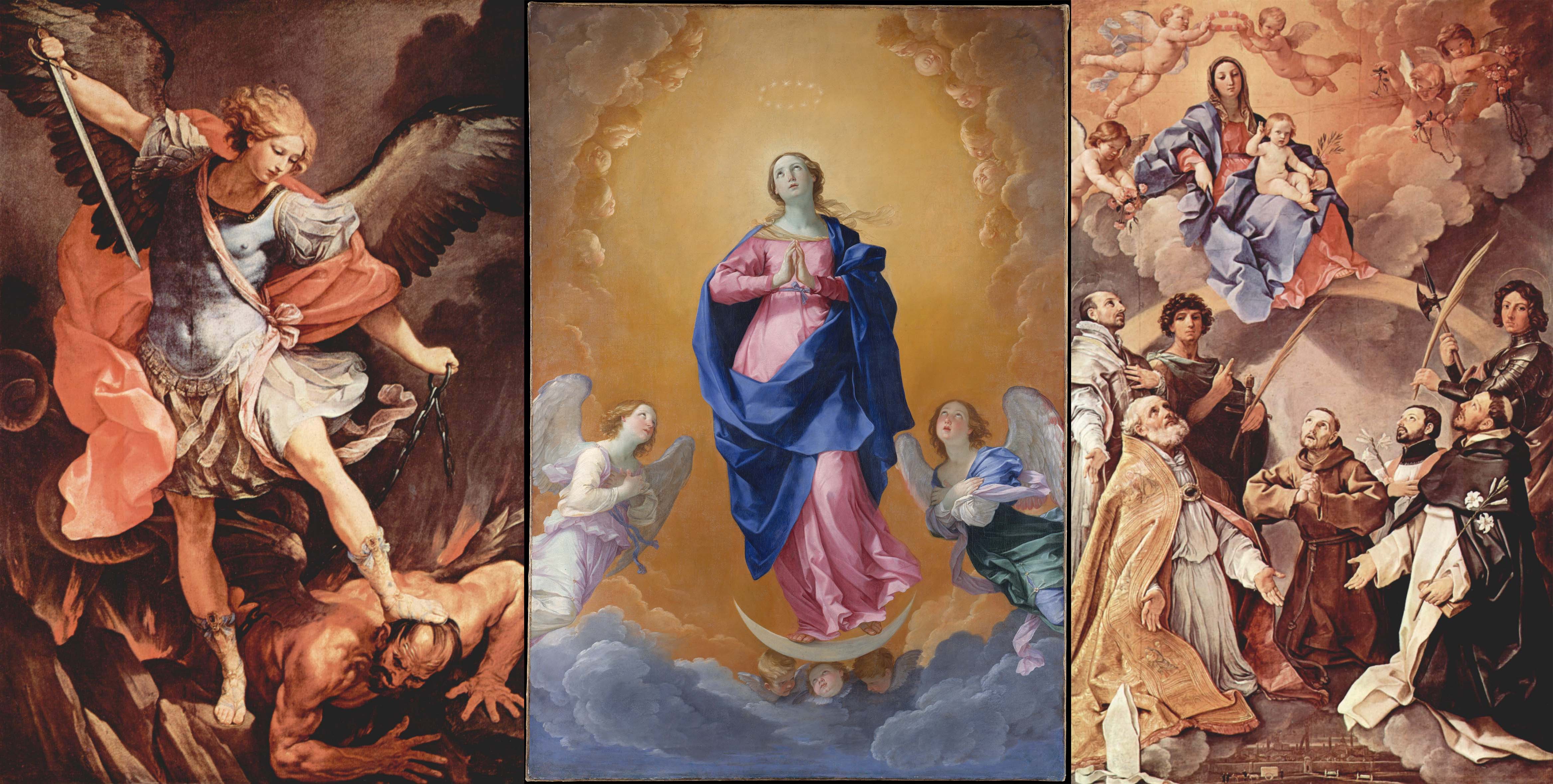
“The Archangel Michael” is one of Guido’s most famous works painted in his second manner when he was strongly under Raphael’s influence. The single devotional figures of the Archangel Michael usually depict him as combining the characters of captain of the heavenly host and conqueror of the powers of hell. According to Jameson, this piece by Guido is the only similar representation of St. Michael that can be compared with that by Raphael in the Louvre[1].
In this work, the Archangel in blue cuirass, red mantle, and violet scarf is poised on out-spread wings, placing his foot on the head of Lucifer. The archangel holds a sword in one hand and a chain in the other, with which he is about to hit the demon into the bottomless pit. The Archangel’s head has blended masculine and feminine graces, with the serene purity of brow and flow of the golden hair surely suggesting divinity.
Compared with Raphael’s Saint Michael Vanquishing Satan of 1518, both works have similar compositions in that they both place the subjects in a diagonal position to create a certain thrust in the scene. The Archangels in both paintings share similar appearances and clothes. In Reni’s work, the Archangel’s attitude is the first to strike the audience and is criticized because the grace is somewhat mannered, while Raphael’s Archangel does not invoke the audience to think about the attitude. Although both works create dynamic feelings of movements through the depiction of the flying cloaks and hair, Reni boldly uses large areas of pink and red to create a visual clue that guides the viewers’ eyes. Reni also simplified the background into unified brown and black, which creates contrast with the highlight on the Archangel. Moreover, while Raphael’s Lucifer is obviously non-human shown by the horns, hair, and strange facial features, Reni’s depiction of Lucifer is less demonized and more humanized with a head that is almost indistinguishable from a human adult. As a result, Raphael’s Lucifer seems to be hopelessly resisting, while Reni’s Lucifer seems to be suffering in deep pain and even sympathetic.
Creator
Guido Reni
Source
Masters in Art: A Series of Illustrated Monographs. Boston: Bates & Guild, 1903.
Motuzas, Alfonsas (2016). "The Folk Piety of Saints Archangels Michael, Gabriel and Raphael in Lithuania". LOGOS-VILNIUS (0868-7692), (86), p. 138.
Pepper, D. Stephen. 1984. Guido Reni: a complete catalogue of his works with an introductory text. New York: New York University Press.
Motuzas, Alfonsas (2016). "The Folk Piety of Saints Archangels Michael, Gabriel and Raphael in Lithuania". LOGOS-VILNIUS (0868-7692), (86), p. 138.
Pepper, D. Stephen. 1984. Guido Reni: a complete catalogue of his works with an introductory text. New York: New York University Press.
Publisher
Wikimedia Commons contributors, "File:Guido Reni 031.jpg," Wikimedia Commons, the free media repository, https://en.wikipedia.org/wiki/File:Guido_Reni_031.jpg (accessed November 28, 2021).
Date
1636
Contributor
Jenny Chen
Rights
The work of art depicted in this image and the reproduction thereof are in the public domain worldwide. The reproduction is part of a collection of reproductions compiled by The Yorck Project. The compilation copyright is held by Zenodot Verlagsgesellschaft mbH and licensed under the GNU Free Documentation License.
Format
293 × 202 cm
Type
Painting
Coverage
Santa Maria della Concezione, Rome, Italy