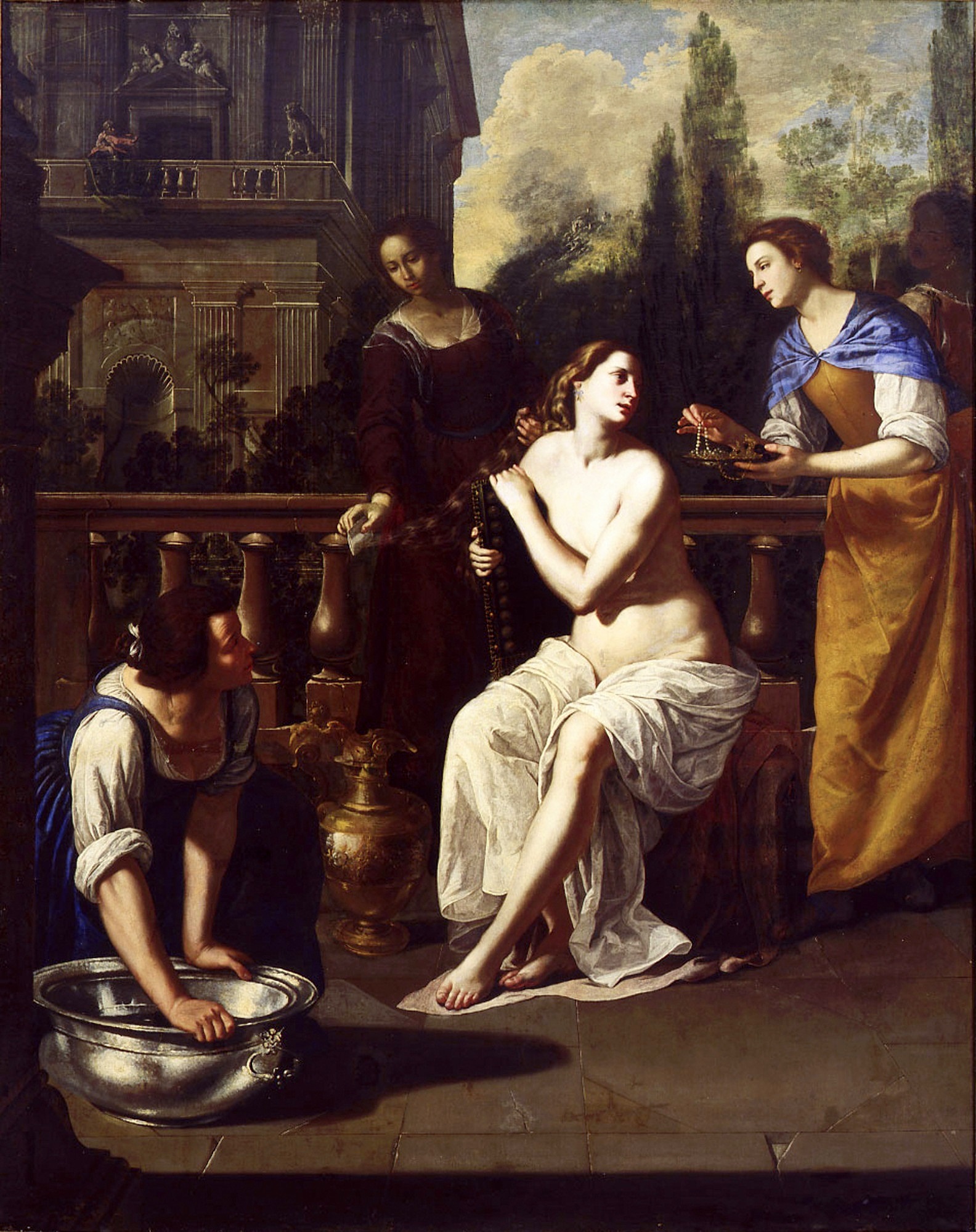
Self Portrait as the Allegory of Painting
Dublin Core
Title
Self Portrait as the Allegory of Painting
Subject
Self-portrait of Artemisia Gentlileschi. She portrays herself in the act of painting.
Description
In this work, Gentileschi depicts herself in the act of painting. Gentileschi most likely completed this painting during her brief English sojourn (1638-c.1641) where she was invited by Charles I to join her father Orazio Gentileschi who had been working in London since 1926.
We see Gentileschi engaging in painting with a brush on one hand and an art palette on the other. She is shown wearing a gold chain and wears a green garment with paint splatters, alluding to her dedication as an artist. She is surrounded by a brown background which could represent the blank canvas she's about to draw on.
Gentileschi depicts herself as the embodiment of the allegory of art. Here, Gentileschi follows the Iconologia of Cesare Ripa, an influential emblem book of the time that represented the art of painting as a beautiful woman "with full black hair" wearing a "chain of gold at her throat which hangs a mask, and has written in front imitation." She applies these descriptions of the art of painting in her self-portrait. She's drawn with unruly locks of hair which represent her frenzied, passionate state as an artist
Creator
Artemisia Gentileschi
Source
Garrard, Mary D. “Artemisia Gentileschi’s Self-Portrait as the Allegory of Painting.” The Art Bulletin 62, no. 1 (1980): 97–112. https://doi.org/10.2307/3049963
Mary D. Garrad’s piece “Artemisia Gentileschi’s Self-Portrait as the Allegory of Painting.” analyzes the historical significance behind Gentileschi’s painting “Self Portrait as the Allegory of Painting.'' Gerrad argues that with this piece, Gentileschi was able to accomplish an art feat that no male artist could ever achieve. In the Renaissance, the allegory of painting was depicted as a female figure who represented the tradition of painting. Here, in this piece, paints herself as the allegory of painting, arguing that she symbolizes the art of painting itself. Many men tried to do this with their own self-portraits but because of their gender, they could never directly represent themselves as the allegory of painting like Gentileschi. She argues this point by comparing different male self-portraits from artists like Titian and Antonio Mario to Gentlischi’s self-portraits, explaining the greater success of Gentileschi's portrait
“Artemisia Gentileschi (Rome 1593-Naples 1652) - Self-Portrait as the Allegory of Painting (La Pittura).” Royal Collection Trust. Accessed October 12, 2021. https://www.rct.uk/collection/405551/self-portrait-as-the-allegory-of-painting-la-pittura.
The National Gallery, London. “Artemisia Gentileschi.” The National Gallery. Accessed October 12, 2021. https://www.nationalgallery.org.uk/artists/artemisia-gentileschi.
Publisher
The National Gallery
Date
1638-9
Contributor
Sofia Silvosa
Format
114.5 x 90.4 x 7.6 cm (frame, external)
Type
Oil Painting
Coverage
British Loyal Collection
Files

Citation
Artemisia Gentileschi , “Self Portrait as the Allegory of Painting,” ARTHIST 256 - Italian Baroque Art - Fall 2021, accessed October 22, 2026, https://www.baroque.dahvc.org/fall-2021/items/show/215.