Esther before Ahasuerus
Dublin Core
Title
Esther before Ahasuerus
Description
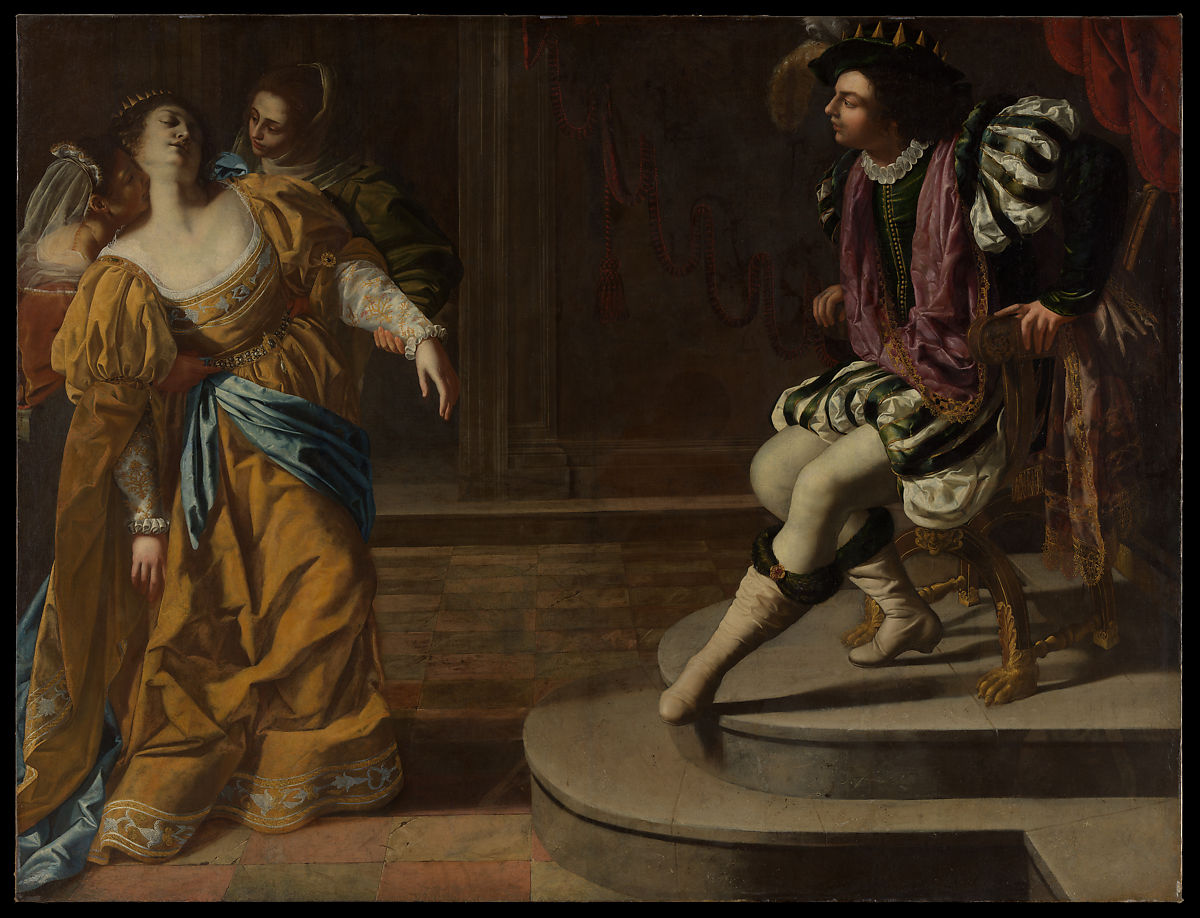
Considered to be one of the most ambitious paintings in Gentileschi’s œuvre, Esther before Ahasuerus exemplifies her success as a female baroque artist. The Old Testament Story referenced here is that of Queen Esther and her husband, Ahasuerus, the King of Persia. The story says that the two were married after his previous wife, Vashti, had offended him. He was unaware of Esther’s jewish faith, and she soon found out that a royal decree to massacre all jews in the Persian empire had been issued. Esther approached the King without a granted request, a crime punishable by death. The imagery of Artemisia’s version falls closely in line with the expanded Greek version of the original Old Testament text, which is quite likely, as it had achieved conical status at the Council of Trent in 1546. Within this text, Esther is described as having “sank to the floor. As she fainted, the color drained from her face and her head fell against the lady-in-waiting beside her. But God changed the king's heart, inducing a milder spirit. He sprang from his throne in alarm and took her in his arms until she recovered, comforting her with soothing words,” [1]. We can see this image come to life in her work as Esther swoons, leaning in fear on one of her maids, and King Ahasuerus is in the midst of rising from his throne, his left foot descending down the dais. Many Notable scholars date this painting to have been created around 1630, just at the end, or after her sojourn in Venice [2]. Considering their striking similarities, it is thought that Artemisia was familiar with Paolo Vernese’s rendition of Esther et Assuérus (Musée du Louvre, Paris), as it belonged to a private collection in Venice at the same time. The circular, tiered dais of the throne, the positioning of Esther’s left hand and the physical relationship of Esther to her maidens are among the similarities.
1. Metmuseum.org. Accessed October 13, 2021. https://www.metmuseum.org/art/collection/search/436453.
2. Och, Marjorie, ed. “Woman's Art Journal, No.1 (2016) 65-66.” Old City Publishing, Inc. Accessed October 13, 2021. http://www.jstor.org/stable/26452063.
1. Metmuseum.org. Accessed October 13, 2021. https://www.metmuseum.org/art/collection/search/436453.
2. Och, Marjorie, ed. “Woman's Art Journal, No.1 (2016) 65-66.” Old City Publishing, Inc. Accessed October 13, 2021. http://www.jstor.org/stable/26452063.
Creator
Artemisia Gentileschi (Italian, born Rome 1593–died Naples 1654 or later)
Source
Mann, Judith W. “‘Identity Signs: Meanings and Methods in Artemisia Gentileschi’s Signatures.’ Renaissance Studies 23, No. 1 (2009): 71–107.” JSTOR. Accessed October 10, 2021. http://www.jstor.org/stable/24417558.
Metmuseum.org. Accessed October 13, 2021. https://www.metmuseum.org/art/collection/search/436453.
Och, Marjorie, ed. “Woman's Art Journal, No.1 (2016) 65-66.” Old City Publishing, Inc. Accessed October 13, 2021. http://www.jstor.org/stable/26452063.
In this article for the Woman’s Art Journal, Marjorie Och discusses Gentileschi’s work through the lens of Jesse Locker’s Artemisia Gentileschi: The Language of Painting. Och organizes the article by taking us through each of Locker’s six chapters, allowing her to touch on many of Locker’s points, including Artemisia’s diplomatic significance in the Papal Court. She quotes Locker in saying that “her talents were utilized in an elaborate series of favors,” as she would often change her style to address her patron’s interests. Most emphasized, however, are Locker’s observed gender dynamics within the Venetian literary environment and how they translated to Artemisia’s work. She comments that although the literary environment of the time, in which Gentileschi flourished, was interested in “the clever woman,” inherent misogyny and the inability to view women as anything but sexual objects stunted their ability to be considered intellectual equals of men. Gentileschi, however, ennobles women in her work, portraying them next to foolish men to emphasize their superiority. This notion is illustrated through her rendition of Esther before Ahasuerus. By comparing her version to that of Veronese, it is clear that Gentileschi studied and rejected his depiction of the King and Queen. She rides the composition of supporting figures, focusing solely on Esther and Ahasuerus. She makes the decision to depict the King in a comedic, theatrical dress, emphasizing the competency of the Queen. In terms of significance, Och’s article is not argumentative, rather it explores and expands on Locker’s ideas and assertions by quoting his work and also using rich imagery to bring his ideas to light. In addition, a photo of Esther before Ahasuerus is set forth, further contextualizing the painting’s discussion.
Date
c. 1630
Contributor
Rebecca Boss
Rights
Public Domain.
Relation
Esther et Assuérus
Date de création/fabrication : XVIe siècle (1500 - 1600)
Paolo Caliari, dit Veronese
Caliari, Benedetto,
Italie, École de
Date de création/fabrication : XVIe siècle (1500 - 1600)
Paolo Caliari, dit Veronese
Caliari, Benedetto,
Italie, École de
Format
Oil on canvas
208.3 × 273.7 cm
208.3 × 273.7 cm
Type
Painting
Coverage
Currently on view at The Metropolitan Museum of Art Fifth Avenue, Gallery 621
Gifted to the Met by Elinor Dorrance Ingersoll, 1969
Gifted to the Met by Elinor Dorrance Ingersoll, 1969
Files
Citation
Artemisia Gentileschi (Italian, born Rome 1593–died Naples 1654 or later)
, “Esther before Ahasuerus,” ARTHIST 256 - Italian Baroque Art - Fall 2021, accessed October 22, 2026, https://www.baroque.dahvc.org/fall-2021/items/show/220.