Lateran Obelisk
Dublin Core
Title
Lateran Obelisk
Description
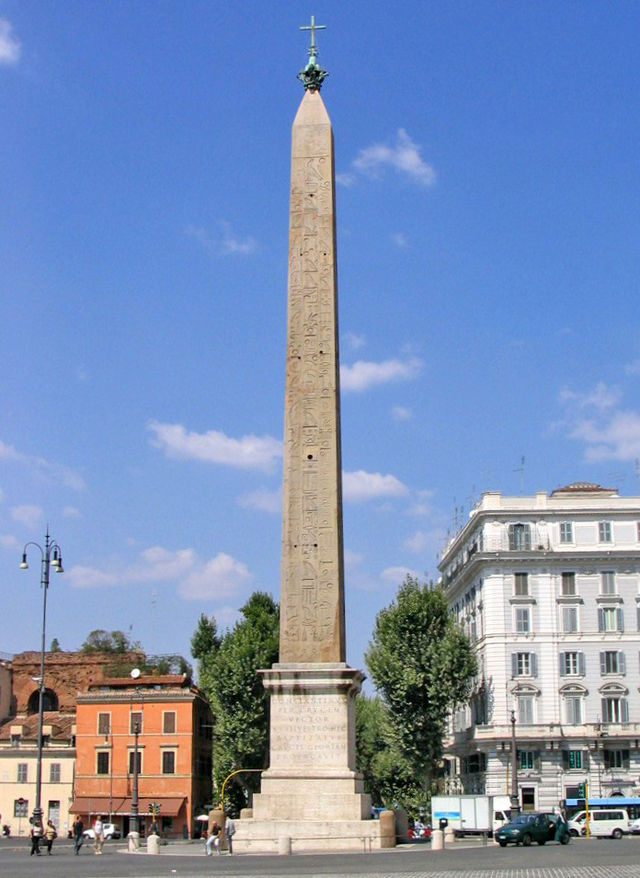
The Lateran obelisk is the tallest obelisk in the world, standing at 32 meters and weighing 522 tons [1]. It is made of red granite, potentially from the same quarry that was used for the obelisk in St. Peter's Square [2]. It was the only single obelisk put up in the Karnak Temple but it was removed by Constantine in a plan to be moved to Constantinople. His son Constantius II took it to Rome in A.D. 357 and it was located in the Circus Maximus. Its inscription at the base dedicates the obelisk to the city of Rome [1].
To provide context of this obelisk’s history in Baroque Rome, this item explores the unearthing process of the Lateran obelisk. Following Fontana’s great success with the Vatican obelisk, three other Roman obelisks were transported in hopes of achieving the same effect. The Lateran obelisk had fallen since its ancient history, and Sixtus V ordered a search to find the obelisk. The search was successful, but the obelisk has been broken up into three pieces. They were found close to Circus Maximus in 1587, about 7 meters below the surface. Matteo da Castello led the excavation, which proved very difficult because they hit a cloaca (ancient drain) in the process. Water rose constantly and five hundred men were needed, with three hundred bailing water at all times [3].
Pope Sixtus V hired Domenico Fontana to lead the relocation to the Piazza of San Giovanni in Laterano. This was very difficult because Fontana’s team had to haul the monolith up the Caelian Hill through very narrow streets [3]. After a year, the obelisk was raised on August 3, 1588 in Piazza San Giovanni in Laterano. It has four lions, a scene telling its history, and a cross on top. The crosses were particularly significant because they signify the obelisks’ connection with Sixtus V and the church. The crosses supposedly held off demon and pagan spirits while drawing in pilgrims to celebrate the divine powers [3].
Creator
Pope Sixtus V
Source
[1] Claridge, Amanda. Rome: An Oxford Archaeological Guide. Oxford: Oxford Univ. Press, 2010.
[2] Sorek, Susan. The Emperors' Needles: Egyptian Obelisks and Rome. Exeter: Bristol Phoenix Press, 2010.
[3] Long, Pamela O. Engineering the Eternal City: Infrastructure, Topography, and the Culture of Knowledge in Late Sixteenth-Century Rome. Chicago: University of Chicago Press, 2018.
[4] “The Lateran Obelisk.” Omeka RSS. Accessed December 2, 2021. http://omeka.wellesley.edu/piranesi-rome/exhibits/show/romanobelisks/the-lateran-obelisk.
Publisher
Pope Sixtus V
Date
1587-1588
Contributor
Cameron DeChurch
Rights
This is a structure that anyone can view.
Format
32 meters and 455 tons
Type
Egyptian obelisk
Coverage
Piazza di San Giovanni, Rome, Italy
Files
Collection
Citation
Pope Sixtus V, “Lateran Obelisk,” ARTHIST 256 - Italian Baroque Art - Fall 2021, accessed October 22, 2026, https://www.baroque.dahvc.org/fall-2021/items/show/294.