Addition to Vatican Library
Dublin Core
Title
Addition to Vatican Library
Description
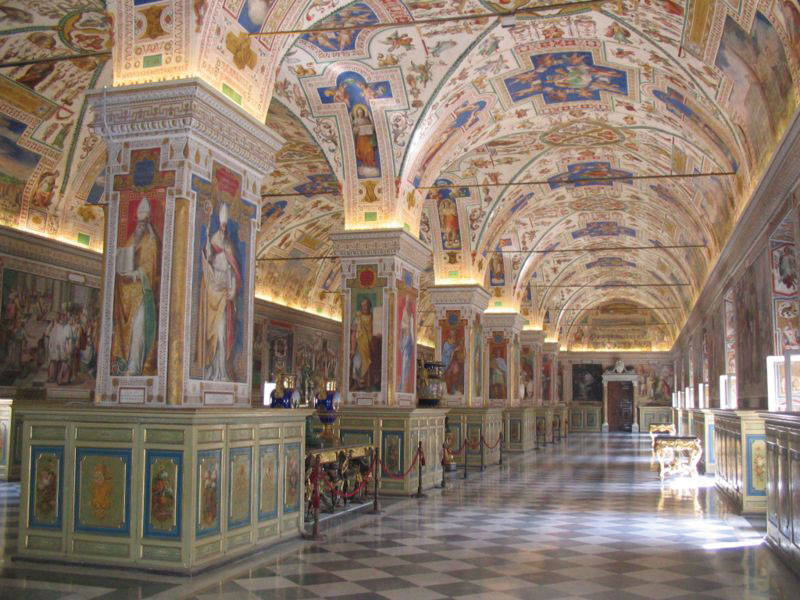
A critical component to Sixtus V’s legacy is his construction of a new Vatican Library [1]. The Vatican libraries date to the 15th century, and grew in significance as the Popes moved from the Lateran Palace to the Vatican. In 1588, Pope Sixtus V sponsored the construction of a new wing across the Cortile del Belvedere [2]. He collaborated with his notable architect Domenico Fontana, who designed the building [3].
His construction of the Vatican Library both adds a new component to his impact through the facilitating of learning and education resources, and also reveals an interesting interpersonal connection with the papacy before him, notably Pope Julius. The specific location of this library was not ideal from a space standpoint. It was cluttered between the large steps and courts, and the south facade felt more cluttered and repetitive as compared to the designs and preferences of Bramante, who constructed the corridors of the Belvedere [3]. Yet, instead of building the library in the spacious west courtyard, Sixtus V chose this location. He did this because even more important the style of the library was the repudiation of what the Cortile del Belvedere had come to symbolize. Julius had a theatre, pleasure gardens, and an overall return to classical ideals, which Sixtus V saw as "pagan" and "inappropriate". Thus, Sixtus V constructed this library to erase Julius's Atrio del Piacere [3].
Sixtus V’s Vatican Library was very impactful both by establishing a new wing to the Vatican’s library construction, and also because the three levels of the Cortile del Belvedere adopted individual identities and purposes as a result. In fact, the court never held another performance like the ones with masses of spectators in the courtyard under Julius [3].
The Vatican Library is especially insightful into Sixtus V’s plans for Rome because not only do they reflect his impressive initiative with construction, but they highlight his desire for a reform in the way religious sites were constructed, specifically with regards to abstinence from “pagan” customs.
Creator
Domenico Fontana
Source
[1] Long, Pamela O. Engineering the Eternal City: Infrastructure, Topography, and the Culture of Knowledge in Late Sixteenth-Century Rome. Chicago: University of Chicago Press, 2018.
[2] MACDONALD, ANGUS S. “THE DISASTER IN THE VATICAN LIBRARY.” Scientific American 146, no. 4 (1932): 226–27. http://www.jstor.org/stable/24965901.
[3] Boorsch, Suzanne. “The Building of the Vatican: The Papacy and Architecture.” The Metropolitan Museum of Art Bulletin 40, no. 3 (1982): 4–64. https://doi.org/10.2307/3258914.
Publisher
Pope Sixtus V
Date
1588
Contributor
Cameron DeChurch
Format
The Apostolic Palace covers 162,000 square meters.
Type
Library
Coverage
Apostolic Palace, Vatican City
Files
Collection
Citation
Domenico Fontana , “Addition to Vatican Library,” ARTHIST 256 - Italian Baroque Art - Fall 2021, accessed October 22, 2026, https://www.baroque.dahvc.org/fall-2021/items/show/303.