Fontana dell'Acqua Paola
Dublin Core
Title
Fontana dell'Acqua Paola
Description
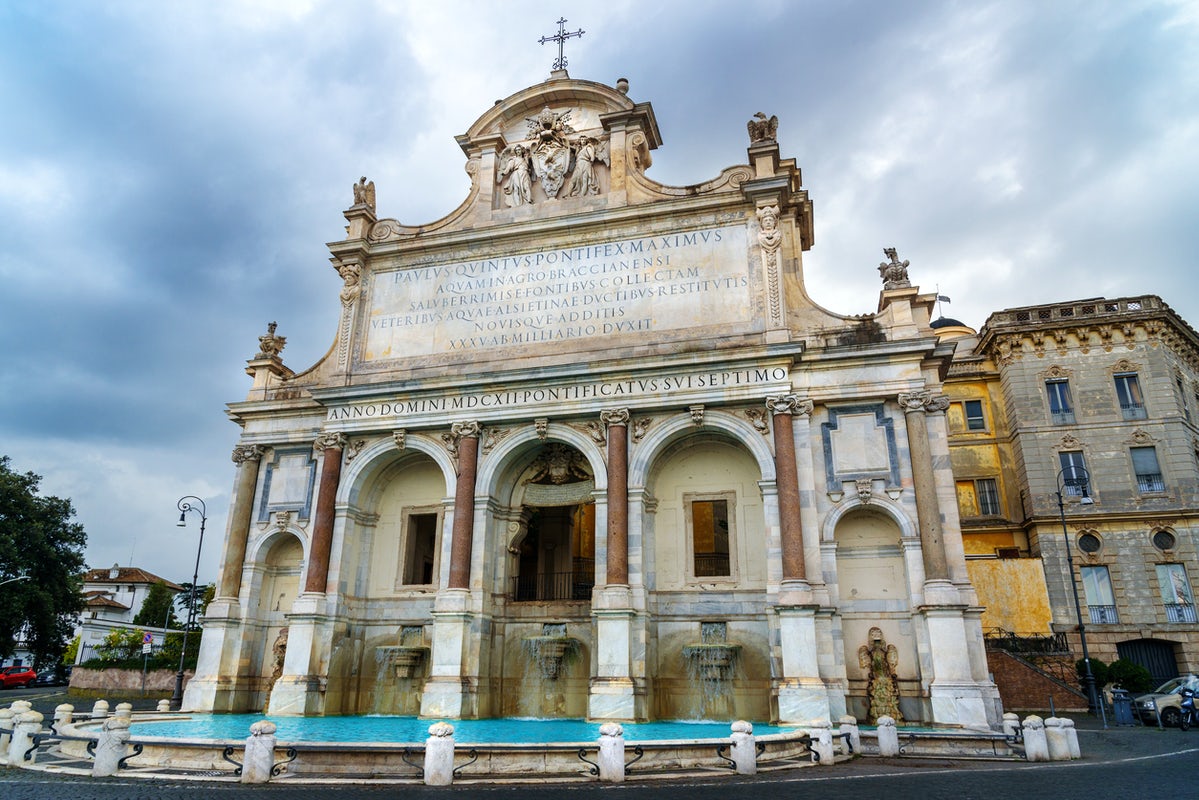
This fountain, built in 1612, celebrates the great engineering feat of Roman aqueducts. Marking the end of the Acqua Paola, the Fontana dell’Acqua Paola celebrates Paul V and his impact on the area. Restoring the existing aqueduct, Pope Paul V created a way for citizens of the Janiculum Hill to get easy access to water, without having to drink the polluted Tiber water. There have been issues with attribution of the fountain, but it was most likely done by Giovanni Fontana and/or Flaminio Ponzio. In the creation of the fountain, the architects needed a grandiose display of Paul V’s legacy. Thus they created the Fontana dell’Acqua Paola.
Resting atop the Janiculum Hill, this fountain is quite an imposing site. Taking inspiration from the preceding Fontana dell’Acqua Felice, the Fontana dell’Acqua Paola contains many similar themes. The fountains both have a shared arch structure, with the Fontana dell’Acqua Paola containing five arches, three large and two smaller, flanking either side. The focus of this fountain is most definitely on the water itself, as no statuary decorates the fountain. This fountain contains a large facade, so that the arches fit into a greater structure. Atop the arches lies an inscription that dedicates the fountain to Pope Paul V. The water seems to gush from the walls in between the columns of the arches, pouring into basins that lie below. The bottom basin that catches all of the overflow was added in 1690 by Carlo Fontana.
This fountain served the role of providing water to the people. For the people of the Janiculum Hill and beyond, trekking to get water from the Tiber or the other aqueducts was the only option for a long time. Yet the Acqua Paola provided a cleaner, easier source of water. Yet had this been the only purpose, the aqueduct would have simply ended, with no fountain. The fountain celebrates many things, especially the papacy. Pope Paul V wanted his legacy remembered for bringing water to the people. Lying on top of a hill, the fountain is very visible in many areas of the cityscape. It stands out, as it stands alone, not built into a piazza or resting in the facade of a building. Additionally, besides holding similarities to the Fontana dell’Acqua Felice, this fountain has many similarities to the Fontana di Trevi. Thus, it is most likely that these two fountains inspired the Fontana di Trevi and were held in high regard by many. Fountains bring art to the people, putting them in public spaces where they are easily accessible. The Fontana dell’Acqua Paola does this to an extreme. By placing the fountain atop of a hill it not only makes it visible to many people for a greater area, but also gives off the impression of the fountain and in extension the dominance of the papacy towering over the viewer.
Creator
Giovanni Fontana
Flaminio Ponzio
Flaminio Ponzio
Source
Connors, Joseph. Alliance and Enmity in Roman Baroque Urbanism. Rome, Italy: Bibliotheca Hertziana, 1989.
The Fountains of Rome, 1986. https://fod-infobase-com.proxy.lib.duke.edu/p_ViewVideo.aspx?xtid=2150.
Heilmann, Christoph H. “Acqua Paola and the Urban Planning of Paul V Borghese.” The Burlington Magazine 112, no. 811 (October 1970): 656–63.
Pulvers, Marvin. Roman Fountains: 2000 Fountains in Rome: A Complete Collection. Rome, Italy: L'Erma di Bretschneider, 2002.
Respighi, Ottorino, Tadaaki Otaka, and Patrick Thomas. CD. The Fountains of Rome. BBC Music Magazine, n.d.
Publisher
Pope Paul V
Date
1612
Contributor
Jacob Carnes
Format
Granite
Type
Fountain
Coverage
Janiculum Hill, Rome, Italy
Files

Collection
Citation
Giovanni Fontana
Flaminio Ponzio, “Fontana dell'Acqua Paola,” ARTHIST 256 - Italian Baroque Art - Fall 2021, accessed October 22, 2026, https://www.baroque.dahvc.org/fall-2021/items/show/331.