Depictions of David
Bernini's David
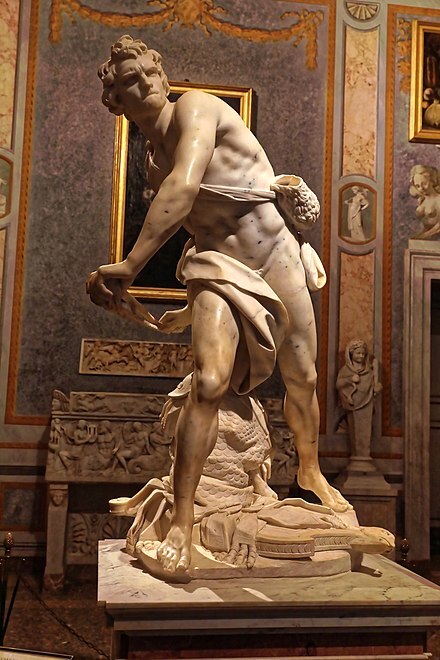
Bernini’s sculpture, David, was commissioned by Cardinal Scipione Borghese for the Borghese Gallery. The sculpture was done in marble over the course of seven months spanning 1623 to 1624 [1].
In the life size sculpture, David is rotating his body in preparation to launch the rock at Goliath. Biting his lower lip and furrowing his eyebrows, David’s face is saturated with tension. He carries a pouch for the rock, and wears a cloth draped around his waist. David’s muscles appear anatomically accurate with muscles flexed emphasizing the tension.
Caught in a moment of tension, Bernini’s David evokes feelings of uncertainty and power. Unlike prior sculptures which capture a moment of victory, Bernini captures the dynamic moment before victory [2]. The viewer almost roots for David to follow through with his throw and defeat Goliath.
Given the composition of the piece, the viewer takes the position of a bystander of the fight between David and Goliath. Rotated around the central point of his abdomen and looking over his pulled forward shoulder, the viewer feels adjacent to the fight, trapped in the events to unfold.
Bernini’s decision to capture a moment of tension and motion in his sculpture demonstrates his ability to break norms surrounding a medium. While sculptures were traditionally used as a medium to express pose and stillness, Bernini embraces motion [3]. His choice to make the viewer an active bystander watching a scene unfold contrasts the typical role of the viewer as a passive observer and admirer - it instead mirrors the motion captured in paintings during the Baroque and Renaissance periods. Through an analysis of Rubens painting of David and Michelangelo’s sculpture, an understanding of Bernini’s command of medium can be fleshed out. With David, Bernini uses sculpture as a mechanism to depict a moment typically constrained to paintings. This demonstrates his ability to think outside the constraints set for media and unit visual art under the theme of capturing moments.
[1] “David .” Galerie Borghèse. Galleria Borghese, July 28, 2021. https://borghese.gallery/collection/sculpture/david.html.
[2] Harris, Beth, and Steven Zucker. “Bernini's David.” Lumen. Accessed December 2, 2021. https://courses.lumenlearning.com/zeliart102/chapter/berninis-david/.
[3] Warwick, Genevieve. “Bernini (1598–1680): Sculpting Sainthood.” Studies: An Irish Quarterly Review 104, no. 416 (2015): 444–55. http://www.jstor.org/stable/24640794.
Rubens' David Slaying Goliath
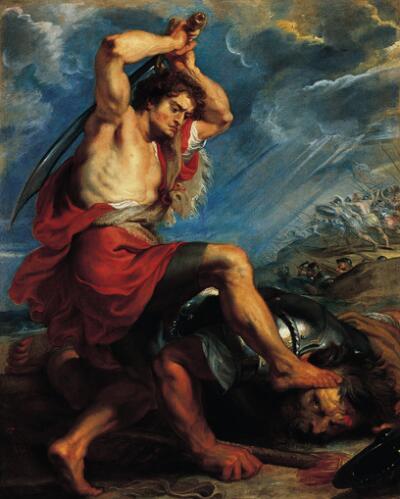
Peter Paul Rubens’ painting, David Slaying Goliath, was painted in oil on a 122.9 x 99.1cm canvas in 1616 [1]. In the painting, Rubens captures the moment where David has over powered Goliath, pushing him to the ground with his foot. David reaches his arms back holding a sword in preparation to strike at David. David’s body is caught in a comment of motion, with his muscles flexed to demonstrate tension. His eyebrows are furrowed and he appears concentrated on the coming strike. Rubens has placed David and Goliath boldly in the foreground, and faded into the background appears a charging army.
Rubens' painting shares several commonalities with Bernini’s David. In both depictions, David’s body and expression is contorted in a moment of tension and uncertainty. While in Bernini’s sculpture, the viewer is uncertain of whether David will defeat Goliath, in Rubens' depiction, it is clear that David has already overpowered Goliath and awaits making his final strike. The viewer takes a similar role in both depictions as an active bystander in a scene of action. Both images show David with his abdomen rotated toward the viewer but his focus turned away, setting the viewer as a part of the scene.
Rubens’ painting featuring bold, coherent colors of red, brown and blue with theatrical lighting and diagonal motion shows themes common to Italian Baroque oil painters like Caravaggio and Artemisia Gentileschi [2]. His use of posture and movement to show tension and place viewers in the scene shows characteristic traits to the Baroque movement.
Rubens' painting was completed about a decade before Bernini's David. Seeing how Bernini was able to capture these Baroque painting characteristics demonstrated by Rubens in his sculpture depiction of David, viewers can understand how Bernini blurred lines between media. His use of these characteristics was novel, as will be made clear through the next analysis of Michelangelo’s David.
[1] “David Slaying Goliath.” Norton Simon Museum, January 1, 1970. https://www.nortonsimon.org/art/detail/F.1972.05.P/.
[2] Freeberg, David. Peter Paul Rubens: Oil Paintings and Oil Sketches. Columbia University, 1995.
Michelangelo's David
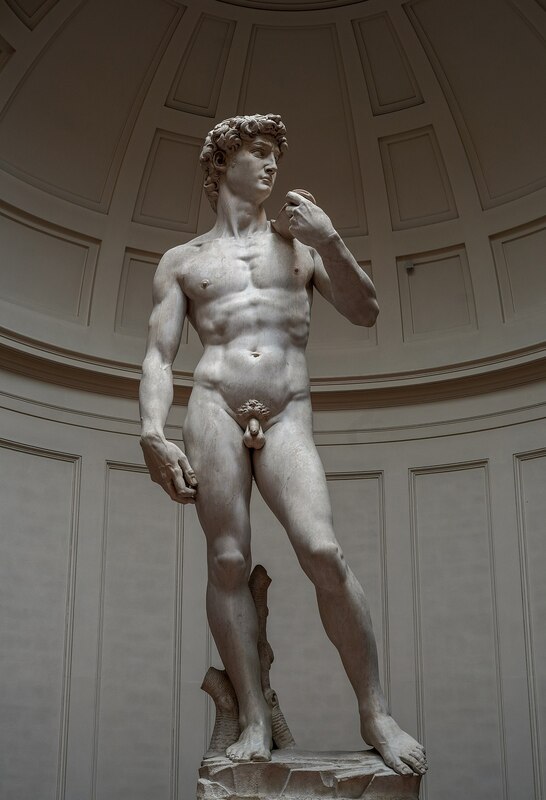
Michelangelo’s David was carved from 1501 to 1504. The statue stands at about 5.5m tall. The marble block used by Michelangelo to carve David had initially been partially used by artists Agostino di Duccio and Antonio Rossellino in the 15th century. Originally commissioned for the cathedral of Florence, the sculpture was ultimately put on the Palazzo Vecchio by the government of Florence. It currently sits in the Accademia [1].
David is thought to be depicted in a moment before the battle. He appears focused with a warning gaze to the right. He is nude and carries his sling over his shoulder in preparation to fight Goliath. David stands upright with a tilt in contrapposto. This pose, iconic to the Renaissance era, signals to the viewer that while David is standing still, he awaits uncertainty and will soon move.
The uncertainty and potential for motion is novel in comparison to other major sculptures of David that came from artists prior to Michelangelo, such as Donatello - in Donatello’s depiction, David stands victorious. Michelangelo’s David shows themes iconic to the renaissance, with his realism of proportions and anatomy, depiction of drapery and history, and contrapposto [2].
Though Michelangelo does depart from the stillness and certainty in previous sculptures, Bernini captures the antithesis of these qualities. Both Bernini and Michelangelo embrace tension and uncertainty, but Bernini couples this with capturing motion.
With the large scale of Michelangelo’s David and placement atop a high pedestal, paired with the stillness and upright nature of the composition, the viewer is not a part of David's scene. Instead, the viewer looks up his figure, almost in admiration. Contrastingly, Bernini’s life size sculpture places the user into the scene and motion unfolding, as does Rubens’ painting. Having been completed a century before Bernini's David, Michelangelo's David shows a prior ideal for the medium of sculpture. This comparison shows how Bernini stands out in uniting visual art media by capturing characteristics of paintings in his sculpture.
[1] “David.” Encyclopædia Britannica. Encyclopædia Britannica, inc. Accessed December 2, 2021. https://www.britannica.com/topic/David-sculpture.
[2] Keizer, Joost. “Giuliano Salviati, Michelangelo and the 'David'.” The Burlington Magazine 150, no. 1267 (October 2008): 664–68. https://www-jstor-org.proxy.lib.duke.edu/stable/40479899?pq-origsite=summon&seq=1#metadata_info_tab_contents.
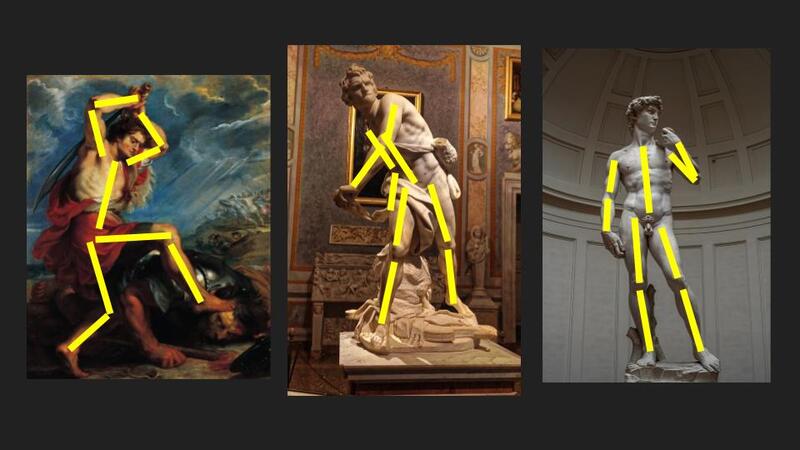
Comparing the pose from the three above images provides an understanding of how Bernini captured the dynamics from Rubens' David and Goliath in sculpture. As is seen by the yellow figure lines, both Bernini and Rubens capture tense, dynamic poses while Michelangelo's David captures a more still contrapposto.