Piante Varie
Piante Varie
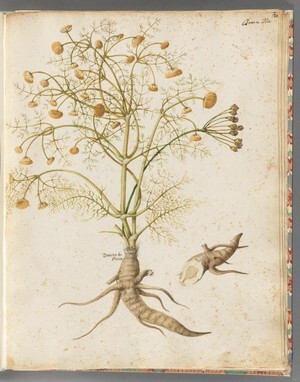
This is a work known as Piante Varie, a collection of paintings of various plants all done by Garzoni in 1650. Known for her still-life pieces, Garzoni hones in on the individual plant, examining shape and form of real plant anatomy. This book contains 50 different plants that Garzoni painted, each of them done in watercolor [1]. Each plant is drawn with scientific accuracy and is similar to that of a scientific observation journal, where scientists go into the field and examine species. She achieved maximum attention to detail in her work and established herself as capable of mimicking reality in these plant drawings. By working for families of power such as the Medici, Garzoni is able to flex her attention to detail by drawing and painting exotic plants that many others would not have access to. This is evident through the broad geographical range these plants cover, from Eryngium montanum found in Mexico to Eryngium ovinum found in Australia [2]. In fact these particular drawings could have been a sort of journal for the Medici family to identify plants within their repertoire, as each piece is accompanied by its species name. In addition to the plants, she drew a self-portrait of Garzoni at age 50 done in red and black ink in the book, as to identify the creator behind Piante Varie. Furthermore, we see the Strozzi family crest present on this page, who, through a marriage in 1508, are related to the Medici family with which Garzoni closely worked. This piece contains a variety of plants from flowers to starches, with cross sections of roots represented in various plants to show the full plant anatomy. In two of the plants, numbers six and eight, Garzoni has hidden her signature within the plant [3]. Click on the image to the left to see the full array of plants!
Flora, ouero, Cultura di fiori
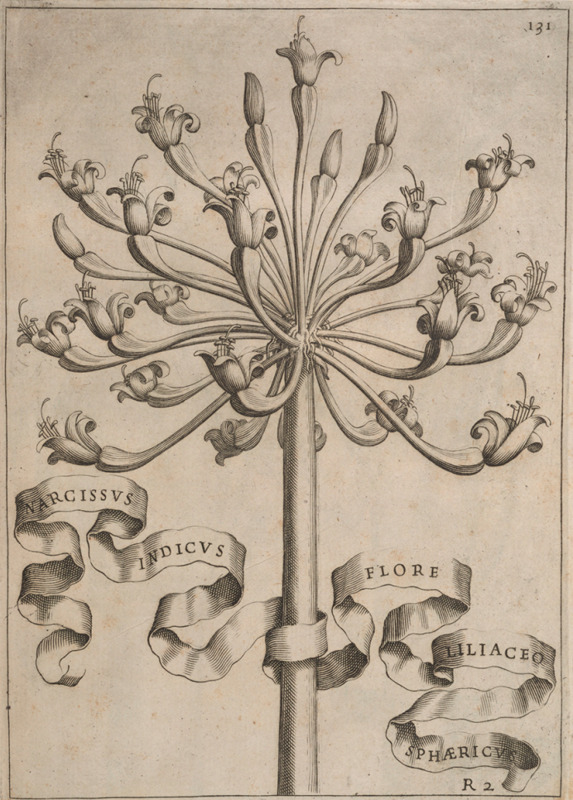
Anna Maria Vaiani is another female artist who did floral designs. In Giovanni Battista Ferrari’s piece on gardening, De Florum Cultura, (1638) Vaiani etched many of the floral designs, including Flora, ouero, Cultura di fiori. Like Garzoni, her designs played on the anatomy of plants with elements of whimsy, to create pieces that were dynamic and alluring. Vaiani learned etching from her father, Alessandro Vaiani [4]. She is known for her botanical etchings, much like the one presented in this book. Both Vaiani and Garzoni led lives as pioneers, where they were some of the first women to create these botanically accurate pieces, that brought inspiration for not only other female artists, but also male artists to explore this approach. This particular etching contains a single stem that buds into multiple flowers on smaller branches, all pointing outwards and upwards. The flowers seem to be in protest to gravity as they hang upwards towards the sky. At the bottom of the stem lies a ribbon with multiple flower names on it, representing the variety of species that Ferrari discusses in his book [5]. Unlike Garzoni's piece, it pays more attention to the structure of the flower in regards to space rather than the physical floral anatomy.
Mapping Piante Varie
This map highlights the location of Flora, ouero, Cultura di fiori in Rome, along with the global influence of Piante Varie with the location of the Eryngium montanum in Mexico.
Works Cited
[2] Garzoni, Giovanna. “Giovanna Garzoni.” Harvard Mirador Viewer. Accessed October 12, 2021. https://iiif.lib.harvard.edu/manifests/view/drs:45882947$16i.
[3] Rare Book Digitization Project. “[Piante Varie].” Dumbarton Oaks, August 19, 2020. https://www.doaks.org/resources/rare-books/piante-varie.
[5] “Flora, Ouero, Cultura Di Fiori.” Duke Library Exhibits. Accessed October 13, 2021. https://exhibits.library.duke.edu/items/show/3987.