Artistic Theme as Identity Precedent
While Spada greatly increased the speed of expansion within the Piazza del Oratorio, the ideals dictating the balance of modesty and grandeur for the Oratorians were given precedent with the artistic program of the Chiesa Nuova. As St. Philip did not ask his congregation to take vows of poverty, it is clear he did not consider wealth an insurmountable obstruction to holiness. He found religious iconography personally useful for inspiring devotion to the Lord, as was common among the devout during the Counter-Reformation. However, St. Philip often sought recluse from the public view, especially in his younger years. The artwork which adorns the altars and ceiling of the Chiesa Nuova struck the balance of not spurning wealth, but seeking to ensure that piety remained a forefront goal, ahead of personal glorification. This balance was the precursor to the leash which the Oratorians placed on Borromini’s design freedoms, as the architect possessed a flair for style beyond that of the Congregation. In choosing masters to execute their major artworks, the Oratorians clearly reveal their aspirations for increased public standing and a focus on the religious experience in this world.
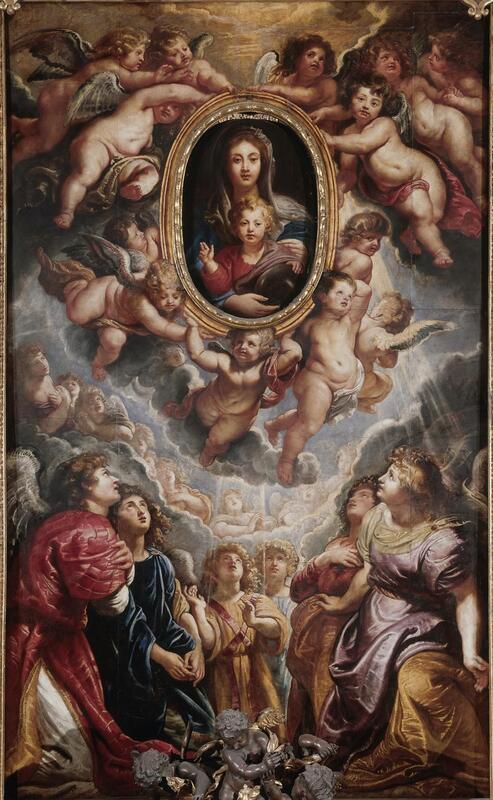
This work by Rubens serves as the high altarpiece for the Chiesa Nuova. It was the second attempt at satisfying the commission and was painted on slate because the first work for the altar was rejected, partly on the account of how the canvas reflected light. The accepted altarpiece proclaims certain central tenets held by the Congregation. Rubens painted the Virgin Mother with the Child who is in the act of benediction on a copper plate. This plate takes the prime focus of the painting and covers an icon which was very important to St. Philip Neri, the Madonna della Valicella. This icon was an older fresco, not to be confused with the painting by Rubens. In keeping with tradition, the icon was to be covered, except on Holy Days, so the copper plate was movable and served the function of covering the icon.
Rubens’ Madonna della Valicella formed part of a triptych for the altarpiece.It very clearly portrays a collections of angels and heavenly hosts adoring the representation of the icon. There is great action produced in this painting, with cherubs contorted in motion, supporting and grasping the iconography. They are swirling about it but have placid faces which bestows a relaxed excitement towards the icon. The color palate is very wide as one moves vertically through the painting. Angels are depicted wearing red, blue, yellow, and purple, and they also gaze up to the icon. Dark clouds increase the concentration of the painting around the icon with alternating levels of clouds forming curved paths of cherubs. The lighting in the painting is a gold source of light unseen from the top, but it reflects off of the upper cherubs and drips down onto the angels.
In light of the first painting which was rejected by the Oratorians, Noyes claims the lack of an explicitly Philippian presence invites the viewer to feel like St. Neri. Instead of viewing Neri’s adoration of the icon, a viewer could live the same experience which Neri felt. With this conspicuous absence, the Oratorians announced themselves fully as a Congregation seeking to emulate the daily life of St. Philip (Noyes, 2017).
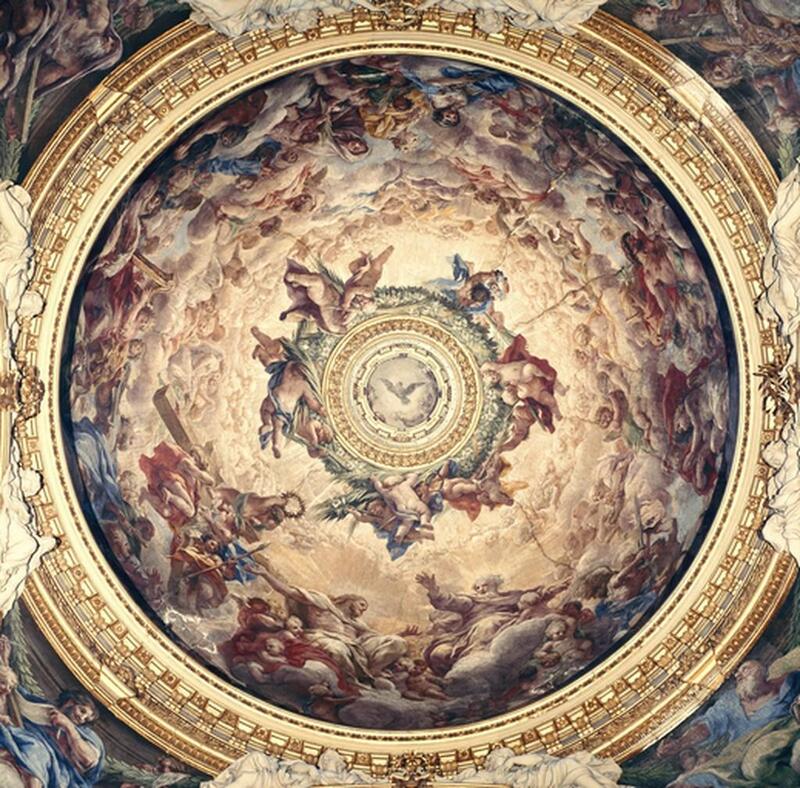
The cupola is home to one of two of Cortona’s ceiling frescoes in the Chiesa Nuova. The other fresco is in the tribuna, and they are historically called “The Trinity in Glory” and “The Assumption of the Virgin”, respectively. Ronen contends that they should be treated as a singular artistic program. This discussion will analyze the cupola and the other fresco will receive consideration elsewhere, so that the viewer of this gallery can evaluate the merit of Ronen’s position (1989).
This fresco takes on a composition almost dictated by the dome it is in, as the figures exist on concentric levels, stretching and swirling towards the apex of the dome. This induces a heavenly effect, with Jesus and other Saints depicted most prominently on the lower circle in bold coloring. Raising the eyes, the second circle is a much lighter cream, with semi-transparent faces of angels and celestial beings filling the space – creating a feeling of heavenly clouds above the humans. This heavenly space converges on a dove at the top of the dome which is encircled by a wreath lifted by angels. This dove is a representation of the Holy Spirit.
Beneath the dove, facing the back entrance of the church are human portrayals of God and Jesus, both elevated above angels with arms outstretched. God seems to be extending his blessings upon the congregation, while Jesus has his arms open wide – a testament to his sacrificial love. When facing the altar, to Jesus’ left is a cross borne by angels who also carry the Crown of Thorns and the Sudarium. The iconography of elements of The Passion reinforces ideas of Jesus’ love. There exist preliminary sketches Cortona made of this crucifix scene and it progressed from more discrete figures with two holding the Cross and the other two with other elements of The Passion. Cortona adjusted to incorporate more dynamism with the subjects intertwined around the Cross (“Drawing by Cortona”). Ronen notes this fresco is unique in that it was the first to depict The Trinity with exclusively Old Testament saints.
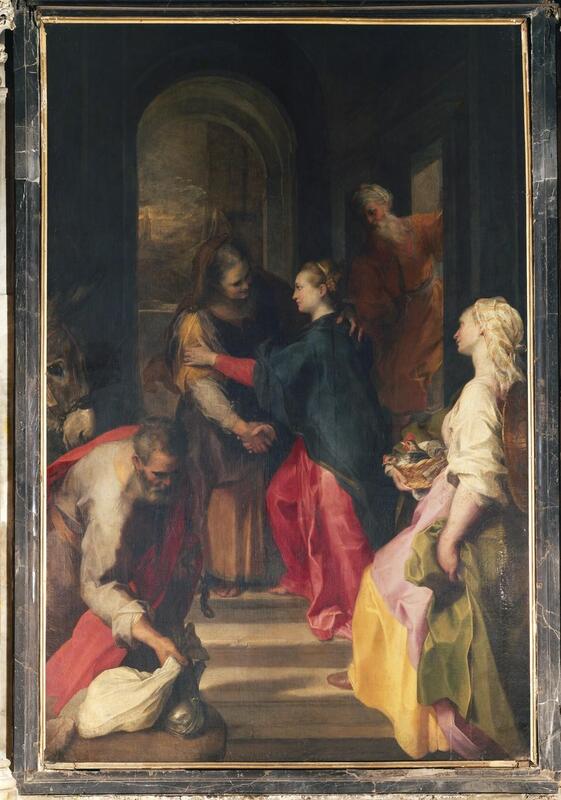
This 1584-1586 painting was the first Barocci delivered to the Oratorians to adorn their church undergoing reconstruction, the Chiesa Nuova. The Oratorians were very particular in control of the artwork for their chapels, so the Pizzomiglio family was allowed to choose from Barocci and one other artist.
This altarpiece handles a significant event in the life of Mary, when she traveled to visit her cousin Elizabeth who was nearing giving birth to John the Baptist. Mary was concurrently carrying Jesus within her womb. It is recorded that John the Baptist leaped joyously within Elizabeth upon hearing Mary’s voice and sensing the presence of Jesus.
The composition of this painting has distinct fore, middle, and backgrounds. Mary and Elizabeth are in the middle ground, with fading lighting, yet they are brought to focus by the orientation of the other human subjects in the painting, as a man in the background and woman in the foreground are both inclined towards them.
In other Barocci paintings, we will see coloring similar to the coloring of this painting, as the background is dominated by uniformity and shades of gray – only interrupted by the man in orange garb, entering the room (Verstegen 2003, 64). Moving to the foreground, the colors on garments become brighter, taking on a characteristically Baroque exaggerated nature.
Barocci cemented the painting back to reality with dynamism that captures the human reality of the Holy. Joseph is bending down to collect his bags, oriented towards the viewer. The woman is carrying chickens and possesses a straw hat which was masterfully painted (64). Even Mary and Elizabeth are in the beginning of an embrace, clutching the other’s hands. After establishing the realness of the moment, Barocci completes the power of the painting with his treatment of Mary and Elizabeth’s faces as they are full of a tender, loving emotion and reciprocally focused on the other. It is a beautiful capturing of faces one might expect from reunited cousins about to become mothers.
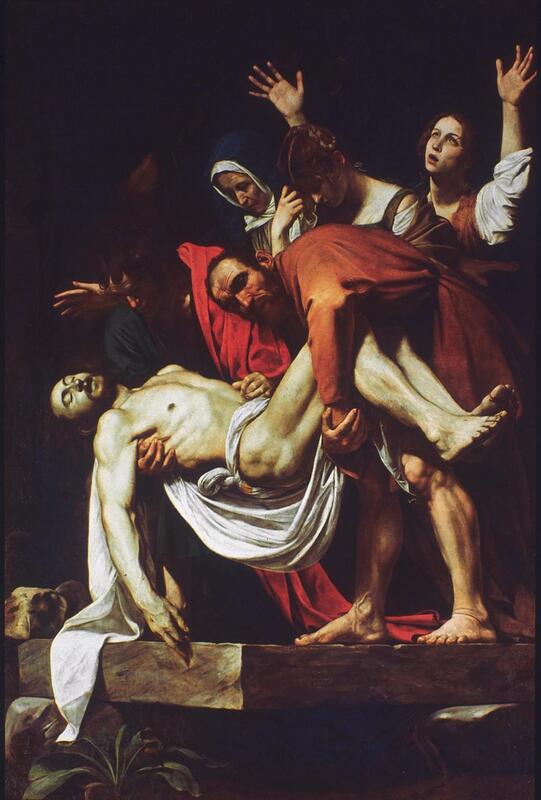
This painting was the altarpiece for the second side chapel on the right side of the nave, which was dedicated to the Pieta and benefitted by the patronage of Vittrice. This painting features six figures and in Caravaggio fashion, strong tenebrism brings the central thrust on the sacred body of Christ. It is a work conveying strong devotion, capturing the weight of the moment, encouraging the viewer to accept the weight of Christ’s body and death. Caravaggio’s talent for realism shines through with the full figure of Christ showing natural musculature. There is a tension in the image, as Nicodemus is bent over, supporting the weight of Christ’s body, as well as the pain of the loss of a loved one.
This pain is continued in the women in the painting - particularly in the faces and bodies of Mary the Virgin, Magdalene, and Cleophas. Mary of Cleophas has her arms outstretched to heaven, indicating the source of strength and meaning in life. It also serves to form a vertical line in the painting, which otherwise would be dominated by the horizontal figure of the Christ. Her arm forms a line with her face, Nicodemus’ face, and Jesus’ face, directly relating the Lord to the suffering of His Son. Nicodemus’ leg flows into her garment, lengthening the image. Magdalene is dabbing away tears, and the Virgin is portrayed in old age, a departure from her typical youthful representation.
On the left side of the image, Saint John fades into the dark background, but his hand is clearly seen wrapped underneath Jesus’ torso (Bellori 1672, 182). All figures are standing on a large slab, adding height above the grave Christ being lowered into. The lighting of this piece makes it seem ordinary, despite the complexity of the composition and figures. The straightforwardness of this work reinforced the focus of the Oratorians on devotion to Christ. It depicted a scene well known in the early Baroque, so that any person in adoration in the chapel would be spurred to greater reflection by the accessible iconography of Caravaggio’s work.
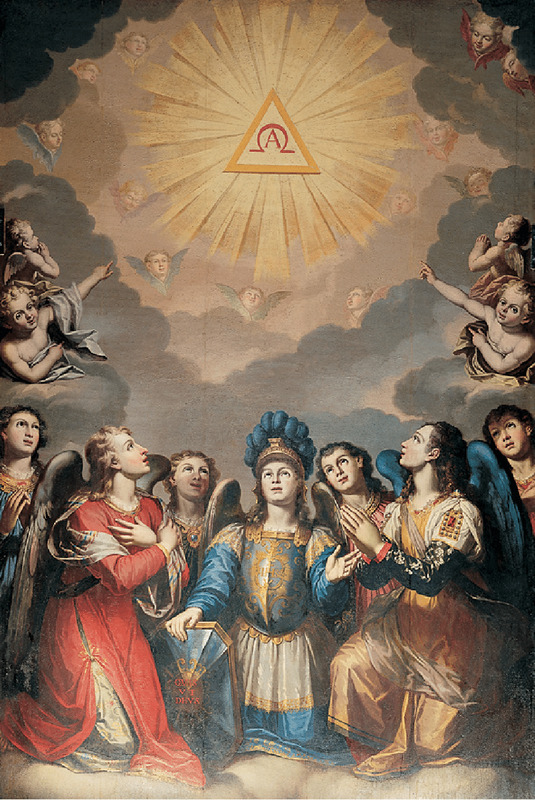
This painting is one of a few well studied canvas paintings in the Gesu. Its artistic program features very heavily on frescoes and sculpture. Because the artistic program of the Chiesa Nuova has numerous oil paintings expressing the themes of the chapels, Zuccaro’s painting is a useful comparative piece. This painting relies on heavy symbolism to represent the Trinity. Radiant beams emanating from a triangle in the heavens are emblematic of the Holy Trinity. The seven archangels on the bottom of the painting add great substance in the foreground. Their gaze is directed upwards, presumably towards the Trinity, bringing attention again to the top of the painting. Adding to this effect, cherubs are gazing at the viewer of the painting with their bodies turned back towards the heavens, arms outstretched, pointing to the Trinity. These cherubs are located in an outer ring of concentric clouds, which lighten around the Trinity.
There is light coming from the Trinity but another source of light seems to strike the archangels from the front, adding to the fictive air of the painting. All of these elements combine to generate negative space in the center of the painting because the Trinity does not take a form. This adds to the religious mystery of the Trinity. Additionally, this painting, with its concentric orientation, appears suited to that of a ceiling fresco, if it were to be transposed.
While a single painting cannot speak to the entire artistic program of the Gesu, there is certainly a disparity between the imagery seen in the Chiesa Nuova. Beginning with Cortona’s cupola, he makes a much less symbolic representation of members of the Trinity when compared to this painting. He does utilize concentric clouds and angels to add an effect of elevating eyes to an implicit Heaven. The altarpieces in the side chapels by Barocci and Michelangelo are both much more simplistic in their color and composition. They examine moments of Saints lives in a snapshot with great detail, rather than a stylized devotional centering around angels. Balass argues the preoccupation with angels and the Trinity was very important to the Jesuits as they were symbols of deliverance in a Counter-Reformation context where Indulgences were no longer practiced (2003, 199-201). The Oratorians distinguished themselves artistically with a preference for the worldly imagery from Saints’ lives. This is firmly grounded in the altarpiece by Rubens, which glorifies the life of the founder of the Congregation, Saint Philip Neri.