Paolo Porpora
The Artist
Paolo Porpora was born in Naples in 1617 and spent the first ten to twenty years of his career in Naples, before moving to Rome [1]. Porpora became a pupil in Giacomo Recco’s bottega (workshop) in 1632 at age 15, as evidenced by a 1632 contract between Recco and Angela Cantalena, mother of Porpora [2]. During his time in Naples, Porpora also trained Giovan Battista Ruoppolo, another renowned Neapolitan still life painter [3]. Similar to his teacher Giacomo Recco, modern scholarship is still working to piece together Porpora’s oeuvre. As suggested by Nicola Spinosa, some of the early marine life compositions attributed to Porpora could perhaps be Recco’s, as little is known about both artists [4]. Starting from 1656, Porpora was in Rome as a member of the Accademia di San Luca [5]. In Rome, Porpora gained esteem as an artist, as evidenced by documentation stating that he had been admitted to the Virtuosi del Pantheon in 1666 [6]. Porpora’s admission into both prestigious institutions serves as evidence for the regard that Porpora’s work was held. While in Rome, Porpora likely came into contact with artists from Northern Europe, including Netherland artists Mathias Withoos and Otto Marseus van Schrieck, who were residing in Rome between 1652 and 1656 [7]. The influence of these Dutch artists is reflected in Porpora’s paintings of baroque flower bouquets, for which he is most well known. Porpora is known mostly as a painter of flowers, although he has created paintings depicting a range of subjects including marine fauna and game. In addition to bouquets, Porpora was also known for his dramatic paintings of sottoboschi (forest floors) including wildlife and flora.
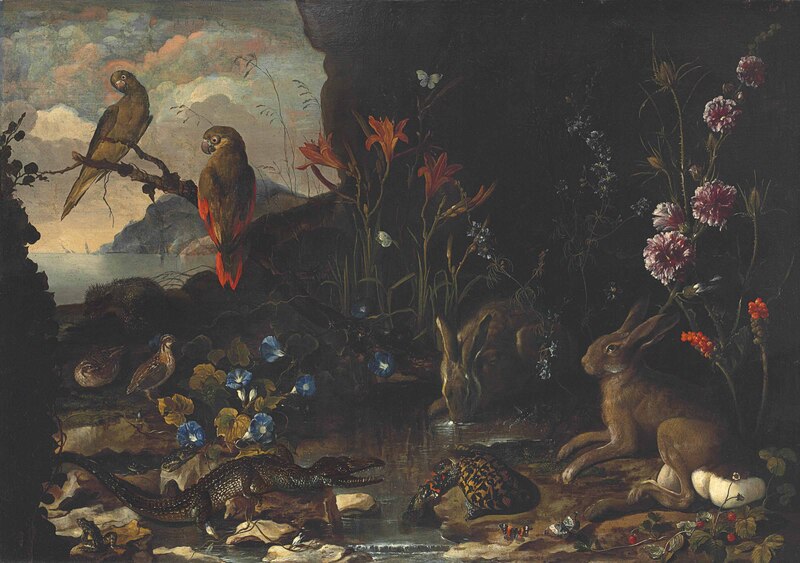
Hares, a tortoise, a crocodile, frogs, quails, a hedgehog, butterflies, dragonflies and parakeets by a pool, with flowers, strawberries and a river in the distance
Hares, a tortoise, a crocodile, frogs, quails, a hedgehog, butterflies, dragonflies and parakeets by a pool, with flowers, strawberries and a river in the distance is an oil on canvas painting created by Paolo Porpora and measuring 121.9 by 172.7 centimeters. This painting, in particular, is a copy of the work Porpora made in 1692 for Cardinal Flavio Chigi [8]. Porpora’s work serves as a helpful comparison for understanding the valuation of still life paintings in both Naples and Rome. Porpora’s work can be closely compared to the Neapolitan context since he was trained in the Recco workshop, and the valuation of his work can be seen directly in the Chigi commission of 1692. In the 1692 commission for Chigi, Porpora was paid 40 ducats for a 112 by 156 centimeter composition of crocodiles and a hare [9]. Porpora’s commissions in Rome prove valuable for further understanding the high economic valuation that still life painting had in Naples over Rome.
Works Cited
-
"Porpora, Paolo." Benezit Dictionary of Artists. 31 Oct. 2011; https://www-oxfordartonline-com.proxy.lib.duke.edu/benezit/view/10.1093/benz/9780199773787.001.0001/acref-9780199773787-e-00144686.
-
Damian Véronique and Claudia Salvi. “Giuseppe Recco.” Essay. In L'œil Gourmand: A Journey through Neapolitan Still Life of the 17th Century: Paris, Galerie Canesso, 26 September - 27 October 2007, 80-81. Paris, France: Galerie Canesso, 2007.
-
Damian Véronique. “Paolo Porpora.” Essay. In L'œil Gourmand: A Journey through Neapolitan Still Life of the 17th Century: Paris, Galerie Canesso, 26 September - 27 October 2007, 46-47. Paris, France: Galerie Canesso, 2007.
-
Damian Véronique, and Nicola Spinosa. “‘Natura in Posa’ in Seventeenth-Century Naples: Progress and Setbacks in Research.” Essay. In L'œil Gourmand: A Journey through Neapolitan Still Life of the 17th Century: Paris, Galerie Canesso, 26 September - 27 October 2007, 8–13. Paris, France: Galerie Canesso, 2007.
-
"Porpora, Paolo." Benezit Dictionary of Artists. 31 Oct. 2011; https://www-oxfordartonline-com.proxy.lib.duke.edu/benezit/view/10.1093/benz/9780199773787.001.0001/acref-9780199773787-e-00144686.
-
Damian Véronique. “Paolo Porpora.” Essay. In L'œil Gourmand: A Journey through Neapolitan Still Life of the 17th Century: Paris, Galerie Canesso, 26 September - 27 October 2007, 46-47. Paris, France: Galerie Canesso, 2007.
-
Causa, Raffaello. La Natura Morta a Napoli Nel Sei e Nel Settecento. 5. Vol. 5. Storia Di Napoli. Napoli, Italia: Società editrice storia di Napoli, 1969.
-
“Hares, a Tortoise, a Crocodile, Frogs, Quails, a Hedgehog, Butterflies, Dragonflies and Parakeets by a Pool, with Flowers, Strawberries and a River in the Distance.” Paolo Porpora (Naples 1617-1670/80 Rome or Naples). Christie's. https://www.christies.com/en/lot/lot-5721193.
-
Marshall, Christopher. “More Beautiful than Nature Itself: The Early Commercial and Critical Fortunes of Neapolitan Baroque Still-Life Painting.” Open Arts Journal 2017-18, no. 6 (2018). https://doi.org/10.5456/issn.2050-3679/2018w07.