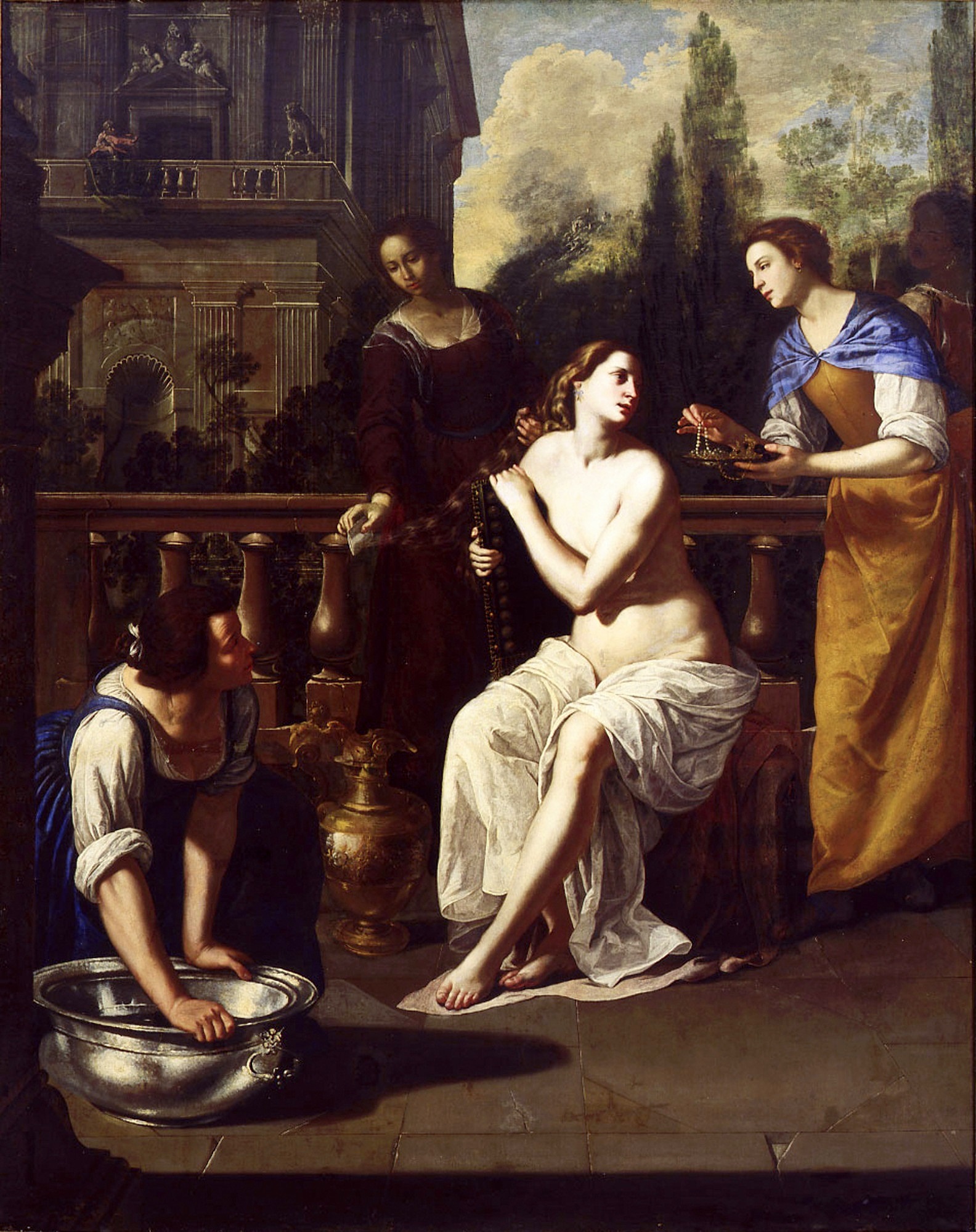
Portrait of a Noblewoman
Dublin Core
Title
Portrait of a Noblewoman
Description
Lavinia Fontana was born and educated in Bologna towards the end of the 16th century. During this time, Bologna was remarkably progressive, compared to other Italian cities, regarding its opportunities for women – both educationally and economically. Indeed, Fontana herself earned a dottoressa in 1580 from the University of Bologna (McIver 1998). This neoteric gender reform helped cultivate a flourishing class of Bolognese noblewomen who had both the time and resources to serve as the financial backbone of Fontana’s urban career. In fact, Fontana’s portraits were praised as an expression of wealth and power for this group. This specific painting depicts Lavinia Fontana’s intimate relationship with the gentildonne Bolognesi – the Bolognesi noblewomen (Muprhy 1996).
While the exact subject of the painting is unknown, the subject is easily recognized as a soon-to-be-wed maiden. The regal, red dress is characteristic of Bolognese wedding gowns of the time (Murphy 1996). The meticulous and colorful brushwork of the subject in the foreground is starkly juxtaposed to the dull, monotone background. This distinction is furthered when considering the intricate jewelry and design. The subject wears a golden chain coalescing into a bejeweled brooch of various rare gems. Fontana’s excruciatingly delicate detailing of the jewelry is characteristic of her noblewomen portraits. Moreover, it is acknowledged that Fontana developed this stylistic element from her father, a painter himself. The status and wealth of the subject are more explicitly denoted by the presence of the cane Bolognese – a costly pet that symbolized prestige.
While the exact subject of the painting is unknown, the subject is easily recognized as a soon-to-be-wed maiden. The regal, red dress is characteristic of Bolognese wedding gowns of the time (Murphy 1996). The meticulous and colorful brushwork of the subject in the foreground is starkly juxtaposed to the dull, monotone background. This distinction is furthered when considering the intricate jewelry and design. The subject wears a golden chain coalescing into a bejeweled brooch of various rare gems. Fontana’s excruciatingly delicate detailing of the jewelry is characteristic of her noblewomen portraits. Moreover, it is acknowledged that Fontana developed this stylistic element from her father, a painter himself. The status and wealth of the subject are more explicitly denoted by the presence of the cane Bolognese – a costly pet that symbolized prestige.
Creator
Lavinia Fontana
Source
Borenius, Tancred. “A Portrait by Lavinia Fontana.” The Burlington Magazine for Connoisseurs 41, no. 232 (1922): 41–40. http://www.jstor.org/stable/861450.
Fontana, Lavinia, 1552-1614. c.1584. Portrait of a Noblewoman. Place: National Museum of Women in the Arts (U.S.). https://library.artstor.org/asset/ARTSTOR_103_41822003064704.
McIver, Katherine A. “Lavinia Fontana’s ‘Self-Portrait Making Music.’” Woman’s Art Journal 19, no. 1 (1998): 3–8. https://doi.org/10.2307/1358647.
Murphy, Caroline Patricia. “Lavinia Fontana: An Artist and Her Society in Late Sixteenth Century Bologna.” Dissertation, ProQuest LLC, 1996.
Murphy masterfully follows the painting career of Lavinia Fontana. Specifically, she pays notice to the many influences that shaped Fontana’s career during the turn of the 17th century in Bologna. Murphy utilizes a hypothesis-driven analysis technique where instead of recounting Fontana’s life, she explores what factors allowed for her artistic success to occur. This leads to Murphy’s use of a thematic analysis roadmap instead of traditional chronological narration.
The third chapter provides an astute investigation into a large portion of Fontana’s financial market – the gentildonne Bolognesi or Bolognesi noblewomen. Murphy discusses the many different factors that helped form this clientele base: financial freedom, education, and personal autonomy among others. It is asserted that these factors were unique to Bologna as it was a relatively progressive city at the time in Italy. The author continues that Lavinia relied on this constant demand to fuel her urban-market workshop. Lavinia depended on commissions for her salary and thus these Bolognesi noblewomen were essential to her success as an artist. Murphy comments that Fontana’s prosperity is largely due to societal forces and movements outside of her control – a common motif found in history. Nonetheless, Fontana developed a close relationship with these noblewomen as Murphy further studies.
Murphy's analysis is well-structured and supported. She relies greatly on primary source accounts of Fontana for contextualization of her arguments. Specifically, she quotes from the work of C.C. Malvasia who wrote extensive biographies on many Bolognesi artists including Fontana. This source provides critical contextualization for how Fontana was able to find success solely through commissions.
Publisher
Lee Stalsworth
Date
1580
Contributor
Michael Greenstein
Rights
Fair use for student assignments, educational presentations, and student or faculty curatorial portfolios
Format
133 x 88 cm
Type
Painting
Coverage
National Museum of Women in the Arts (U.S.)
Still Image Item Type Metadata
Original Format
Painting
Physical Dimensions
133 x 88 cm
Files

Collection
Citation
Lavinia Fontana, “Portrait of a Noblewoman,” ARTHIST 256 - Italian Baroque Art - Fall 2021, accessed October 22, 2026, https://www.baroque.dahvc.org/fall-2021/items/show/223.