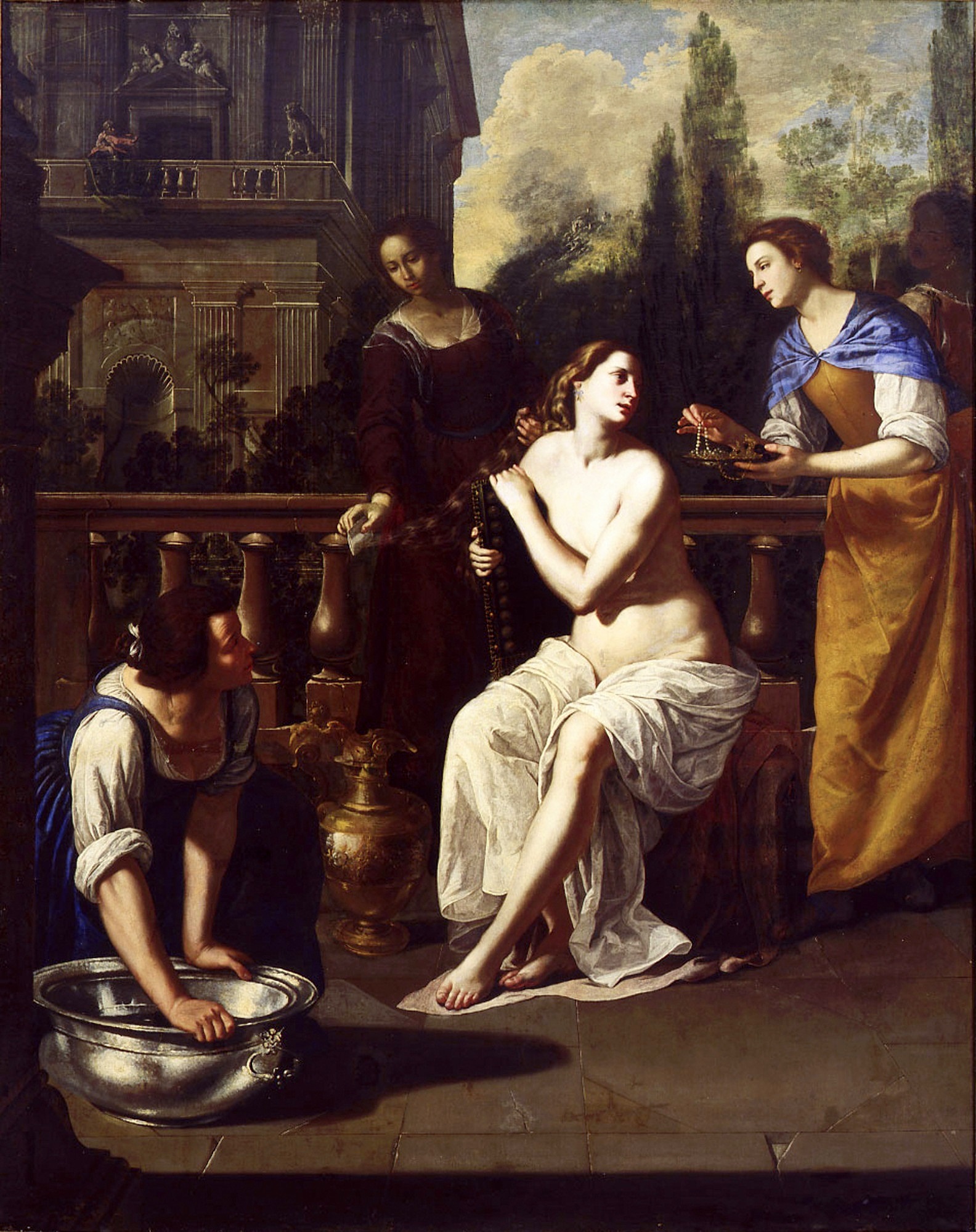
Self-portrait at the Clavichord
Dublin Core
Title
Self-portrait at the Clavichord
Subject
A self-portrait of Lavinia Fontana
Description
This self-portrait of Lavinia Fontana depicts the artist playing the clavichord, an appropriately cultured activity for a rising noblewoman. The seated Fontana is resplendent in an intricate red gown decorated with jewels and a lace collar. Brightly lit and assertive in the foreground of the image, she looks directly at the viewer and engages with them as she plays. A maidservant enters in the middle ground in a dynamic gesture; she is leaned forward towards Fontana as she holds a book of sheet music. In the background, a small, empty easel makes reference to Fontana's artistic profession. The text in the top left corner names Fontana as the artist, confirms her status as a virgin, and dates the piece.
This portrait was created for Fontana's intended father-in-law, Severo Zappi, and makes several allusions to the marriage and its social implications. Her red dress quotes the traditional Bolognese wedding gowns of the time, and a small red love knot is visible sitting on the clavichord. Her expensive clothing, musical knowledge, and access to servants affirm her well-off social standing.
Apart from consideration of the intended audience, Fontana portrays herself as the ideal form of the woman artist at the time: she is both beautiful as a woman and talented in expressing that beauty. She asserts her "gentildonna" status and participates in activities befitting such a status. The inclusion of the easel signifies her ownership of her artistic profession, a growing trend in self-portraiture for artists of the time.
Creator
Lavinia Fontana (1552-1614)
Source
Bohn, B. (2004), Female self-portraiture in early modern Bologna. Renaissance Studies, 18: 239-286. https://doi.org/10.1111/j.0269-1213.2004.00057.x
This source gives a chronological overview of female artists of sixteenth- and seventeenth-century Bologna and their practices regarding self-portraiture. It provides comparisons both between these women’s portraits and between female self-portraits and their male contemporaries. One section of the essay examines Lavinia Fontana’s five self-portraits--four paintings and one drawing--including the Self-Portrait at the Clavichord, referenced here as Self-Portrait at the Keyboard. Bohn expands on the portrait’s background, including its purpose as a self-promotion to Fontana’s future father-in-law and its assertion of the woman as a professional artist.
McIver, Katherine A. “Lavinia Fontana’s ‘Self-Portrait Making Music.’” Woman’s Art Journal 19, no. 1 (1998): 3–8. https://doi.org/10.2307/1358647.
This source contrasts Fontana’s Self-Portrait at the Clavichord, here titled Self-Portrait Making Music, with other portraits of her time which featured the artist pictured with musical instruments. Musical instruments included in portraiture relate to the ideals of the figure in a cultured society, in terms of both gender and profession; the standards for artistic and educational merit were high among the nobility of Bologna. Here, Fontana stands out as not only a virtuous, well-educated woman but also as an active participant in her artistic trade and a model for the commodified female self-portrait.
Publisher
Lavinia Fontana, 1552-1614. 1577. Self-portrait at the Clavichord. Place: Accademia nazionale di San Luca. https://library.artstor.org/asset/ARTSTOR_103_41822003064654.
Date
Created 1577
Contributor
Eliza Henne
Rights
The Service Platform and Content. The Service platforms and any trademarks, issued patents, and patent applications, copyrights and copyright registrations and applications, rights in ideas, designs, works of authorship, derivative works, and all other intellectual property rights (collectively, “Intellectual Property”) relating to the Service platforms are proprietary to ITHAKA and all Intellectual Property related to the Content provided by ITHAKA’s participating libraries, universities, publishers, scholarly societies, and other Content contributors are proprietary to them, subject to the rights of third parties.
Format
Oil on canvas, 27 x 24 cm
Type
Painting
Coverage
Accademia nazionale di San Luca, Rome, Italy.
Files

Collection
Citation
Lavinia Fontana (1552-1614), “Self-portrait at the Clavichord,” ARTHIST 256 - Italian Baroque Art - Fall 2021, accessed October 22, 2026, https://www.baroque.dahvc.org/fall-2021/items/show/224.