Self-portrait
Dublin Core
Title
Self-portrait
Subject
A self-portrait of Sofonisba Anguissola
Description
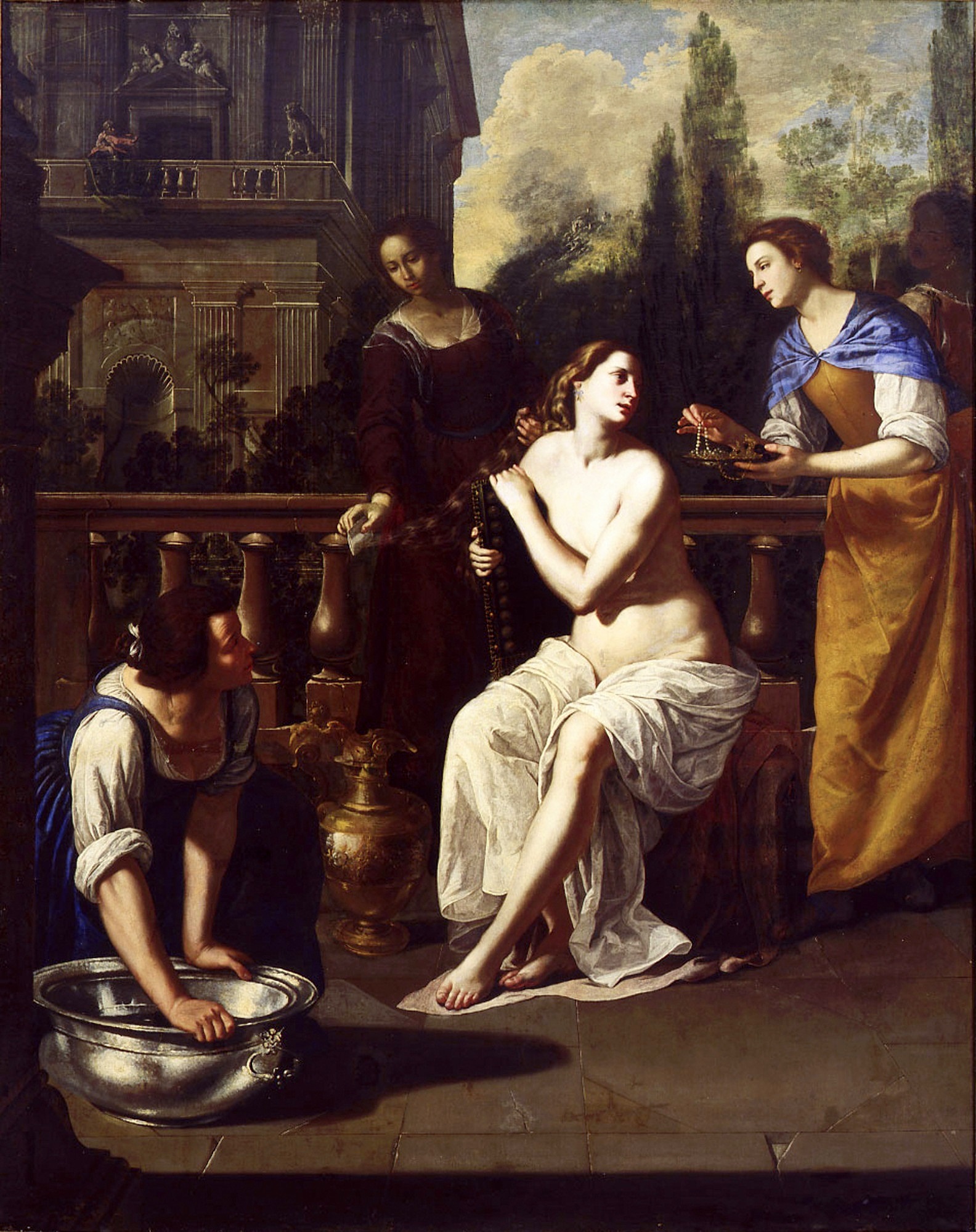
This self-portrait of Sofonisba Anguissola depicts the artist seated at a keyboard and accompanied by an older maidservant. Anguissola wears a dark brown, somewhat unembellished gown with a small frilled collar and cuffs. She sits very tall and poised, facing and making eye contact with the viewer, and her face and hands are the brightest points in the image. The maidservant is more dimly lit but still appears very close to the foreground, as if sitting directly beside Anguissola. The figures are set against a nondescript background whose color gradation accentuates the focus to the right of the image, where Anguissola sits.
Several physical and background elements of this portrait are almost identical to Fontana's "Self-portrait at the Clavichord." The primary female figure dominates the foreground as she sits at her instrument, and a female servant supports her as a background character. The artist supports both a female ideal of beauty and the skill needed to properly express that beauty in the art of painting.
The most striking difference between the two self-portraits is the overall presentation of the woman in her space. Fontana's portrait sets her in her chambers, well-dressed and inviting interest with the details of her surroundings. She is visibly well-off and is willing to assert her place as both female nobility and artist. The background of Anguissola's portrait is bare, apart from color variation, and Anguissola herself is dressed more plainly and in more neutral colors. These contrasting elements may be a result of the intended audience for each portrait; Anguissola's place as a courtier likely influenced the poised but not exuberant portrayal of herself, as compared to Fontana's bright, warm, context-laden likeness.
Creator
Sofonisba Anguissola (1532-1625)
Source
McIver, Katherine A. “Lavinia Fontana’s ‘Self-Portrait Making Music.’” Woman’s Art Journal 19, no. 1 (1998): 3–8. https://doi.org/10.2307/1358647.
This source draws several comparisons between Fontana’s Self-Portrait Making Music and Sofonisba Anguissola’s portrait of similar name and subject matter. Both indicate a gentildonna appropriately well-versed in the arts--both painting and musicianship--actively using their artistic talents while accompanied by a maidservant. Several distinctions, including the subject’s clothing, the setting surrounding the figures, and the color scheme of the painting as a whole, contrast Fontana’s and Anguissola’s work and give insight into the purpose and context for which the portraits were created.
This source draws several comparisons between Fontana’s Self-Portrait Making Music and Sofonisba Anguissola’s portrait of similar name and subject matter. Both indicate a gentildonna appropriately well-versed in the arts--both painting and musicianship--actively using their artistic talents while accompanied by a maidservant. Several distinctions, including the subject’s clothing, the setting surrounding the figures, and the color scheme of the painting as a whole, contrast Fontana’s and Anguissola’s work and give insight into the purpose and context for which the portraits were created.
Publisher
Sofonisba Anguissola (Italian painter, ca. 1532-1625 ). creation: 1561. Self-portrait. painting, paintings. https://library.artstor.org/asset/AMCADIG_10312186652.
Date
Created 1561
Contributor
Eliza Henne
Rights
Please note that if this image is under copyright, you may need to contact one or more copyright owners for any use that is not permitted under the ARTstor Terms and Conditions of Use or not otherwise permitted by law. While ARTstor tries to update contact information, it cannot guarantee that such information is always accurate. Determining whether those permissions are necessary, and obtaining such permissions, is your sole responsibility.
Format
Oil on canvas, 83 x 65 cm
Type
Painting
Coverage
Minneapolis College of Art and Design Collection, Minneapolis, Minnesota, USA.
Files

Collection
Citation
Sofonisba Anguissola (1532-1625), “Self-portrait,” ARTHIST 256 - Italian Baroque Art - Fall 2021, accessed October 22, 2026, https://www.baroque.dahvc.org/fall-2021/items/show/225.