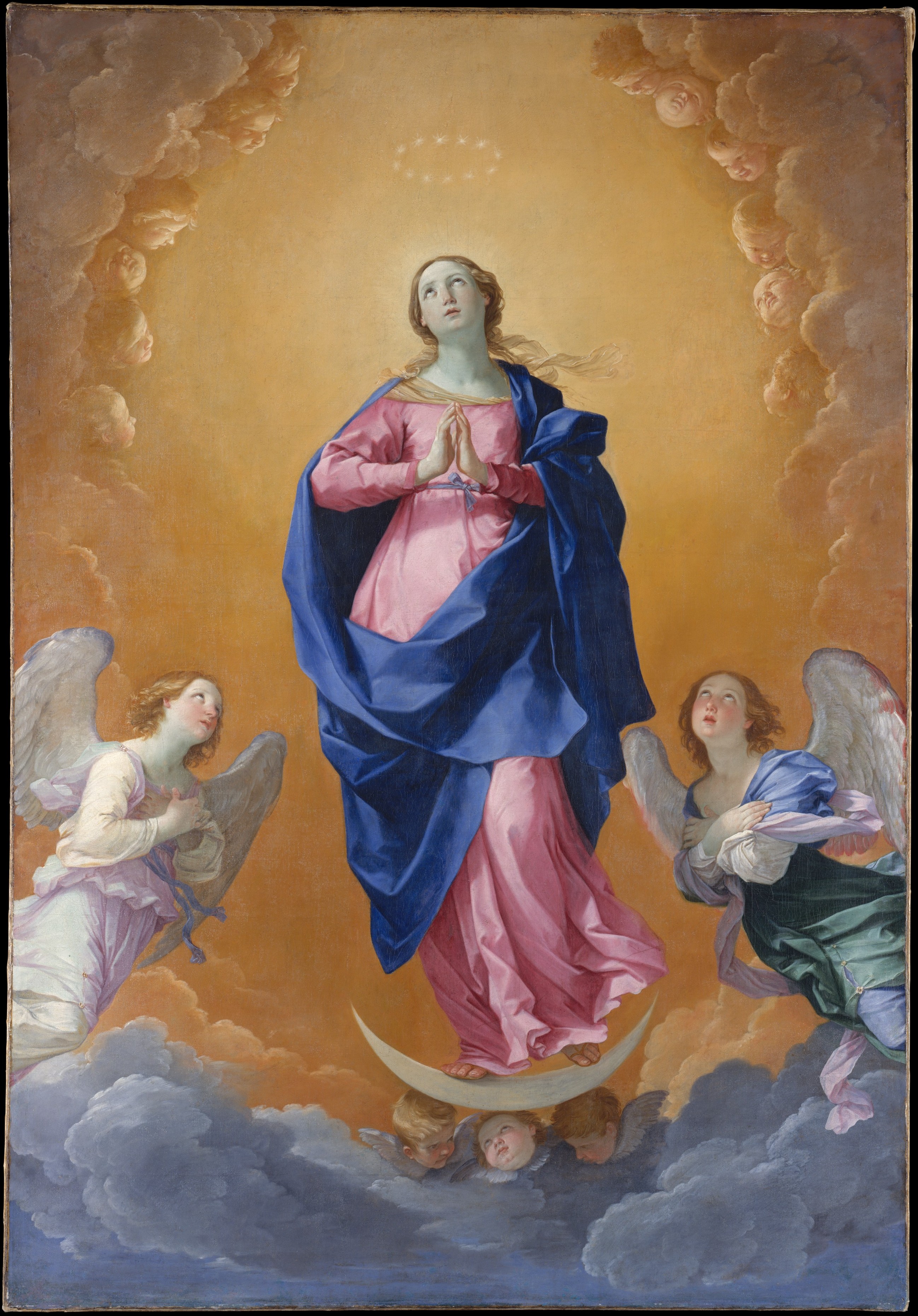
The Immaculate Conception
Dublin Core
Title
The Immaculate Conception
Description
In the eyes of G. B. Passeri, a contemporary biographer, Guido Reni was "the noblest, most majestic painter who ever lived- not only in my own opinion, but by common consent.” Reni, the most celebrated Italian painter of the seventeenth century, was particularly famous for the elegance of his compositions. He was also a master of painting beautiful female heads, earning him the epithet “Divine.”
Reni’s Immaculate Conception is a documented work of historical importance and high quality. This altarpiece was commissioned in about 1627 by the Spanish ambassador in Rome for the Infanta of Spain. It later hung in the cathedral of Seville and exercised a deep influence on Spanish painters, especially Murillo. In this work, Reni was trying to paint a picture of the Virgin to satisfy his own vision of heaven. Mary’s Immaculate Conception had a long history since the Middle Ages with the meaning that Mary was free from original sin at her conception as opposed to her sinless conception of Christ. In the formal representation of the Immaculate Conception, one shows Mary before her life on earth.
In this piece, Mary stands on the crescent moon with her upturned head and eyes directed towards heaven. Mary’s flawless features express her purity, and her hands devoutly joined in prayer. Seen against a golden aura, bordered by ethereal heads of putti (cherubim), she is adored by two angels, who gaze at her in reverence. Their upward gaze was a signature in Reni’s religious works, which is derived from Raphael’s Saint Cecilia. Wearing her traditional pink robe and blue mantle, Mary is crowned by a circle of twelve stars. The idealization in the faces, the cool hues of the draperies and clouds, the golden glow of the heavens, and the porcelain-like treatment of skin tones have made the work one of the prime early examples of what the seventeenth-century Bolognese biographer Carlo Cesare Malvasia wrote as Reni’s "secondo maniera," or second manner, where a blond tone and delicacy replace the more strongly modeled forms of his "first manner."
Creator
Guido Reni
Source
Hibbard, Howard. “Guido Reni’s Painting of the Immaculate Conception.” The Metropolitan Museum of Art Bulletin 28, no. 1 (1969): 19–32. https://doi.org/10.2307/3258470.
Pepper, D. Stephen. “Guido Reni’s Practice of Repeating Compositions.” Artibus et Historiae 20, no. 39 (1999): 27–54. https://doi.org/10.2307/1483573.
Pepper, D. Stephen. “Guido Reni’s Early Drawing Style.” Master Drawings 6, no. 4 (1968): 364–431. http://www.jstor.org/stable/1552913.
Pepper, D. Stephen. “Guido Reni’s Practice of Repeating Compositions.” Artibus et Historiae 20, no. 39 (1999): 27–54. https://doi.org/10.2307/1483573.
Pepper, D. Stephen. “Guido Reni’s Early Drawing Style.” Master Drawings 6, no. 4 (1968): 364–431. http://www.jstor.org/stable/1552913.
Publisher
Reni, Guido. “The Immaculate Conception,” 1627. The Metropolitan Museum of Art. New York, NY, United States. https://www.metmuseum.org/art/collection/search/437423.
Date
1627
Contributor
Jenny Chen
Format
268 x 185.4 cm
Type
Painting
Coverage
The Met Collection, Metropolitan Museum of Art, New York City, United States
Still Image Item Type Metadata
Original Format
Painting
Files
Collection
Citation
Guido Reni, “The Immaculate Conception,” ARTHIST 256 - Italian Baroque Art - Fall 2021, accessed October 22, 2026, https://www.baroque.dahvc.org/fall-2021/items/show/245.