Canuti: Embracing Illusionism
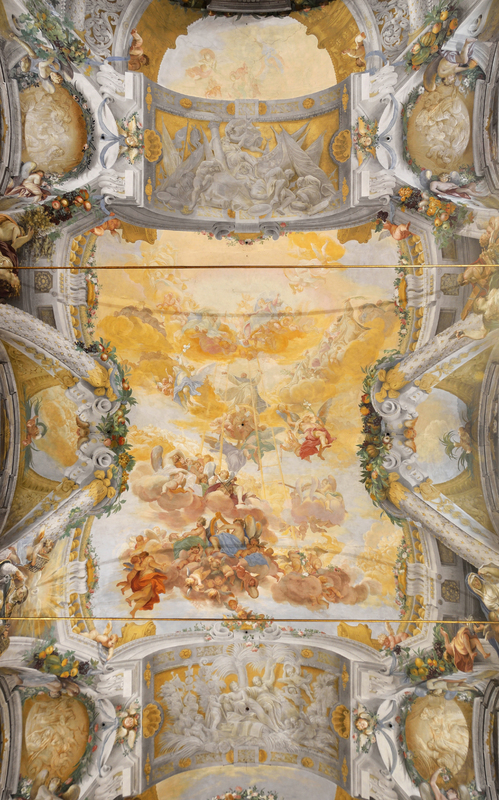
Apotheosis of St. Dominic
Domenico Maria Canuti (1625-1684) was active when the Baroque period was in full swing, and his fresco Apotheosis of St. Dominic on the ceiling of SS. Domenico e Sisto is a bright application of the illusionistic precedent set by Pietro da Cortona. In the center of the main panel, the hazy St. Dominic rises through the air towards an even more indistinct Virgin and Child, partially obscured by the brilliantly lit golden atmosphere. The viewer’s eye is drawn up towards the “apex” of heavenly light by the clouds, which form semicircular platforms enforcing the deepened perspective [1]. The design of the intricate fictive stucco work forming a rectangular “frame” was not Canuti’s work but that of Enrico Haffner, a specialist in quadratura, indicating collaboration made necessary by the demand for illusionistic ceilings at the time [1].
Analysis
Viewed through the same lens as Veronese’s and Cortona’s work, Apotheosis of St. Dominic is a dynamic combination of con termine and senza termine imagery, depending on the focal point. For the most part, the human and angelic figures are all pictured con termine, resting on clouds that recede into the air and contribute to the sense of upward depth with their layered pattern. However, the clouds themselves are depicted senza termine, as might be expected--these are not outcroppings of solid land or concrete architectural features. The figures, by extension, become part of the floating bodies unrestricted by the frame or the walls, as free in their space to descend as to ascend, and technically senza termine. Considering that Canuti did not design the quadratura framework to accompany his main fresco, he may have intentionally avoided significant interactions between the figures and the “stucco” to minimize stylistic conflicts. Regardless, the increase of senza termine work may point to a growing confidence in the execution of illusionistic ceilings, implying an established place for the discipline in the tastes of the contemporary patronage.
References
- Thomas Poensgen. “Some Unknown Drawings by Domenico Maria Canuti.” Master Drawings 5, no. 2 (1967): 165–224. http://www.jstor.org/stable/1552874.