Decline of the Illusionistic Ceiling
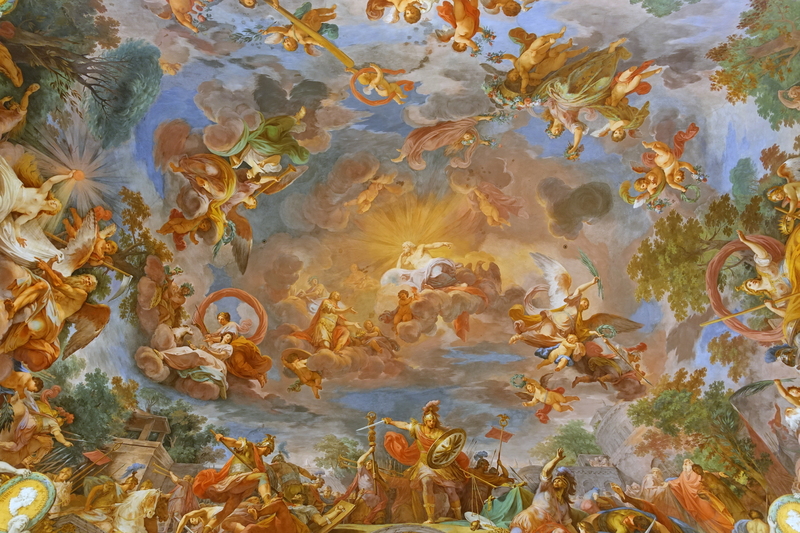
Camillus, Allegory of Glory
By the late 18th century, the Baroque period was all but over, and the prevalence of the illusionistic ceiling declined with it. Mariano Rossi (1731-1807) was influenced strongly by the Baroque style, but his work also incorporates the incoming habits of non-illusionistic ceilings, which were experiencing a revival in the late 1700s. Rossi’s fresco in the Borghese Gallery in Rome, Camillus, Allegory of Glory, is a prime example of artistic meshing during the transitional period between the Baroque and emerging Neoclassicism. The radial design of the fresco centers around Jupiter and other godly beings witnessing the Roman leader Marcus Furius Camillus in battle against the Gauls, in which Camillus triumphs and becomes a figurehead for the newly freed Rome [1]. Although the mythological iconography fits the standard of the Baroque illusionistic ceiling, the color palette is brighter and the perspective is less focused on the use of di sotto in su depiction than this fresco’s predecessors. The crowded allegorical figures recall Cortona’s Barberini ceiling, but the higher saturation of color, lack of characteristically deep shadows, and relative absence of quadratura mark the Camillus fresco as distinctly departed from the Baroque ceiling in its purest form.
Analysis
During the turnover period between Baroque and Neoclassicism, the favored style of ceiling decoration was shifting from the existing di sotto in su illusionism to the quadro riportato form [1]. Quadro riportato describes a non-illusionistic style that simply places a framed painting, specifically one that might exist on a vertical wall, on a ceiling without converting its perspective to match the spectator’s di sotto in su viewpoint. The Camillus fresco does incorporate some elements of Baroque illusionism; Jupiter and the surrounding figures exist senza termine, and the one-point perspective of the piece is the apex of the sky in which they float. However, the peripheral figures exhibit more of the return to non-illusionistic painting. Camillus and the rest of the land-bound figures are pictured within a detailed landscape, and not from a very sharp lower angle as typical di sotto in su might suggest. Bodies are shown in full length rather than foreshortened, as are the trees and other landscape elements, so the perspective effect is that of a typical wall painting and not an extension of the room into the sky. The revival of a more classical taste--the heart of Neoclassicism--meant the omission of starkly realistic spatial manipulation in favor of more stylized, antiquity-inspired forms.
References
- Carole Paul. “Mariano Rossi’s Camillus Fresco in the Borghese Gallery.” The Art Bulletin 74, no. 2 (1992): 297–326. https://doi.org/10.2307/3045873.