Fontana delle Api
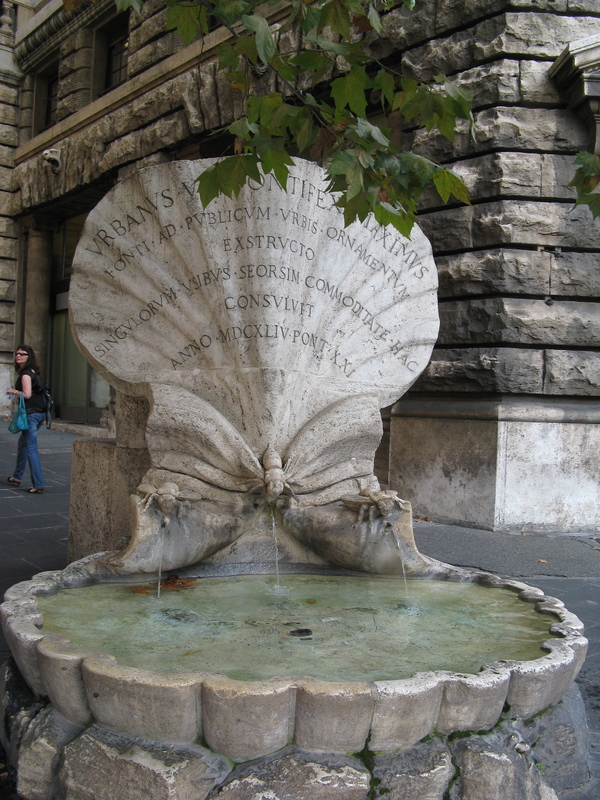
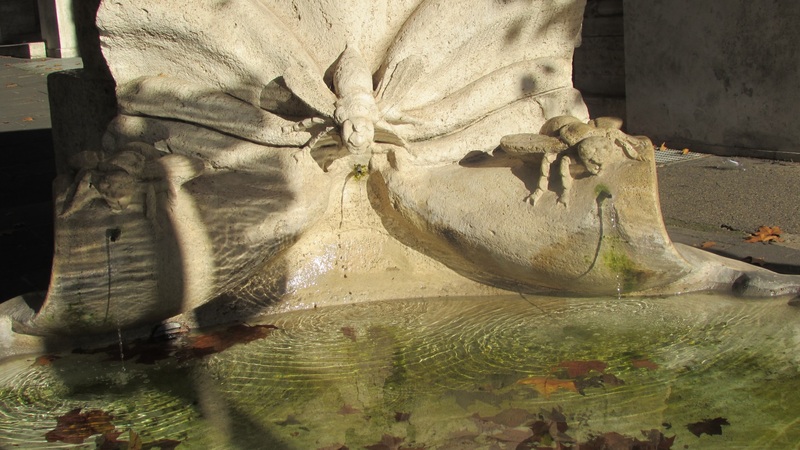
Located alongside the Fontana del Tritone in the Piazza Barberini, the Fontana delle Api is a subtler fountain. Commissioned by Pope Urban VIII, the fountain was completed in 1644 by Gian Lorenzo Bernini, only a year after the Fontana del Tritone. The fountain was completed only a few months before Pope Urban VIII passed away and is thus one of his last accomplishments as the papal head. As a member of the Barberini family, Urban VIII paid homage to his roots in many ways, one of which being the bees.
The fountain consists of a shell placed upright with writing on it. The writing pays tribute to Pope Urban VIII and the year in which the fountain was established. Additionally, the fountain contains three large bees on the shell that appear to be heading downwards into the water. As a symbol of the Barberini family, the bees represent Urban’s family and the patron himself. Some citizens took critique with Urban VIII’s constant use of funds for flagrant fountains and exuberant architecture. They were angry with the taxes they faced to pay for such displays of wealth. Thus they claimed the fountain represented bees drinking honey instead of making it, to criticize how the papacy was spending money instead of creating an income for the state.
The Fontana delle Api is special amongst this list, as it is one of the only fountains that is not the centerpoint of the piazza in which it resides. Rather, this fountain lies off to the side, concealed from the direct view. Additionally, this fountain is of a smaller stature, thus it is not as grandiose as the Fontana del Tritone that resides in the same piazza. This creates an interesting dynamic, where the Fontana delle Api rests in the shadow of the Fontana del Tritone. Yet this is what Bernini and Urban VIII wanted. They wanted a more private fountain. This fountain is one that many people just ignore. Thought to be used as a watering trough for horses, the importance of this fountain was meant to be less than that of the Triton in the center of the piazza. Yet, there is still a radiant importance to this fountain. It creates its own bubble in the corner of the piazza that creates a calming atmosphere.