Browse Exhibits (12 total)
Ascension: Illusions of the Baroque Ceiling
This examination of the illusionistic techniques used in Italian Baroque ceiling paintings and frescoes explores the question of the boundaries of reality in the intention of the painter. In these endeavors of illusion, what is the proper place of the spectator in the experience of the mythological and the divine, and how is that position communicated?
Bernini and the Unity of Visual Arts: Beyond the Medium
An exploration of Bernini's works to understand his "Unity of Visual Arts."
Bernini's Mythological Sculptures
Background
Gian Lorenzo Bernini is considered to be one of the important artists from the Baroque period and is considered to be one of the most influential artists of all time. He was born in Naples in 1598 and from a young age was considered gifted in the arts.
His marble sculptures are his most celebrated works with groundbreaking biblical works like the David and The Ecstacy of St. Theresa. However, many of his most renowned sculptures, which encompass an earlier point in his career, include his mythological sculptures. Many of these sculptures depicted Greek and Roman myths.
During the Baroque period, alongside several biblical works, we see a large number of mythological artworks– a continuity from the Renaissance period. Bernini’s works are no exception. His mythological sculptures are famous for their dynamic composition and emotional storytelling.
Significances and Influences
This collection explores some of Bernini's most notable mythological sculptures and tackles to understand why Bernini was so intrigued by these myths and how he was able to communicate these myths through sculpture. The exhibition will examine the many factors that directly influenced Bernini's creation of these mythological works including the artistic training Bernini received from his father and his patronage to Cardinal Borghese. Moreover, this exhibition will also examine the influence of Ovid's The Metamorphoses and how it was used as Bernini's main source of inspiration for these mythological works.
Finally, on a broader scale, this exhibition will also explore the use of mythology in the Counter-Reformation period and its place in Baroque art.
Il Pittore e La Pittrice: Female Equality in the Arts
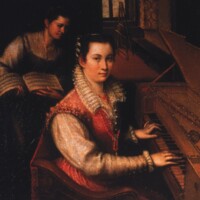
Introduction
In Italian, the word for painter (like many other professions) is distinctly gendered. The male painter or il pittore is seperated from that of the female painter, la pittrice. While the words refer to the same career, the linguistic differentation alludes to a deeper partitioning within the art field. Indeed, since the Baroque times, the female artist is not offered the same respect and pay compared to her male counterparts. In order to combat such inequality, it is essential to bring light to those who have found avenues of success against the odds of gendered subjection.
Lavinia Fontana exemplfies this ideal, standing as a trailblazer for women in the arts.
Lavinia Fontana was a Bolognese artist who specialized in portraiture. Unlike many of her contemporaries, she started from humble beginnings and not from nobility. Indeed, her father, Prospero, was an aspiring artist in Bologna while her mother came from a long line of typographers. Nonetheless, from a young age, Fontana was introduced to the arts and painting. Her father served as her initial teacher - hoping that Lavinia could help with the financial burden set on the family.
Early in her career, Fontana worked on smaller projects that entered into her father’s workshop. Here she began refining her craft and emulated many of her father’s techniques. Whereas her male counterparts received formal training in art schools or apprenticeships, Fontana was initially rejected entrance to the Carracci family academy of painting. She relied solely on these smaller commission projects passed on by her father to refine her artistic ability in real-time. Later in her career, after initially establishing her reputation, she went on to earn a degree from the University of Bologna - uncommon for women at the time.
And yet, Fontana found success in the arts. As she began to work independently in the Bolognese urban market, she supported her parents, husband, and eleven children. Fontana truly stands as a pioneer for women in the arts. Her unwavering resolve as she competed directly against other male artists at the time for a commission-based salary highlights her resolve. It is only fitting that Lavinia became idolized by the female nobility of Bologna and relied on their demand for her works just as they coveted her portraits.
Moreover, many of her works depicted nude female subjects. This was extremely taboo at the time for female artists were prohibited from using live nude models. However, in a sense, Lavinia pioneered a movement of reclaiming rights to the female form through her nude art.
The following pieces illuminate Fontana's succesful art career. Through the comparisions with her contemporaries, Fontana's unique ability to compete within the urban financial markets and provide for herself and her family is emphasized.
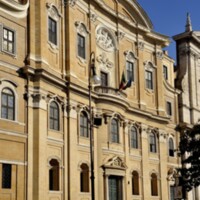
Pope Sixtus V: Rome's Transformative Urban Planner
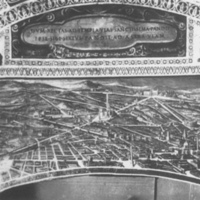
This collection explores the extent to which Pope Sixtus V (born Felice Peretti Montalto) transformed Rome into a Baroque city. In the middle of the sixteenth century, Rome was still very much an ancient city with poor infrastructure. As the sixteenth century came to a close, Rome has undergone immense transformation, with the rebuilding and construction of churches, palaces, roads, aqueducts, and more. Although he was not the only pope involved in this transformation, Pope Sixtus V stands out as a key figure. Sixtus V was nothing short of a visionary, whose body of work highlights his innovative urban planning as head of the Catholic Church (1585-1590).
In order to truly evaluate Sixtus V's impact, this exhibit pays note to context. Late sixteenth-century Rome's most powerful figure was its governing pope [1]. Since each pope came from his own family and had unique interests and backgrounds, the changes made during a particular papacy heavily reflect the desires of that particular pope. Thus, this exhibit examines Sixtus V's predecessors and successors. Popes before him such as Sixtus IV, Julius III, Paul IV, Pius IV, Pius V, and Gregory XIII did not concentrate their efforts on urban design to the extent that Sixtus V did [1]. Although they were focused on important issues such as wars, reformation, enforcing decrees from the Council of Trent, and the education of the clergy, their impact on Rome is not highlighted as much through urban structures and design [1]. Popes after him such as Urban VII (1623-1644) seem to be inspired by Sixtus V, putting more emphasis on art patronage.
Sixtus V still impacts Rome today through the lasting impact of his urban planning. This exhibition showcases Sixtus V's design of the city and analyzes his different mediums for reshaping Rome. This exhibit explores Sixtus V's remodeling of the streets, his building of the fountain Fontana Felice, the Lateran Palace, the Dome of Saint Peter's, the Vatican Library, his financing of the Pontine Marshes, and his moving of obelisks into key piazzas and streets.
References:
[1] Long, Pamela O. Engineering the Eternal City: Infrastructure, Topography, and the Culture of Knowledge in Late Sixteenth-Century Rome. Chicago: University of Chicago Press, 2018.
Repetition and Innovation: Guido Reni's Religious Works
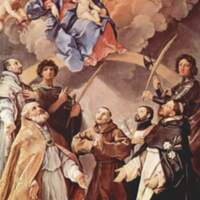
Introduction
Guido Reni (1575-1642) was an Italian painter of the Baroque period and a dominant figure in the Bolognese School. In 1584, Reni entered the workshop in Bologna of the Flemish painter Denys Calvaert, where he studied anatomy, perspective, low reliefs, and Old Master painters. Reni left Calvaert and transferred to the more humanistic Carracci academy in 1594. His principal teachers at the academy were Ludovico and Agostino Carracci. By 1598, Reni had apparently left the Carracci academy, after having quarreled with Ludovico, as he had done earlier with Calvaert.
In his early career, Reni executed important commissions for Pope Paul V and Scipione Cardinal Borghese, painting numerous frescoes in chapels. In his religious paintings, Reni evolved a style that tempered Baroque exuberance and complexity with classical restraint. His iconic compositions show his preference for gracefully posed figures that mirror antique ideals. In the later part of his career, Reni employed lighter tones, softer colors, and extremely free brushwork.
The main inspirations for Reni’s art include the work of the Carracci family and the frescoes of Raphael. Reni strove toward a classical harmony in which reality is presented in idealized proportions. The mood of his paintings is calm and serene, as are the studied softness of color and form. His religious compositions made him one of the most famous painters of his day in Europe, and a model for other Italian Baroque artists.
The Exhibition
This exhibition is structured to answer this question: to what extent and by what means are Guido Reni's religious art pieces innovative?
Although Reni has been questioned for being repetitive and limited in his compositions, he did have innovative accomplishments in terms of his unique iconography of the mythological figures and his critical inheritance of Raphael and the Carracci's.
The first part of the exhibition reflects Reni's repeating compositions.
- Saint Sebastian
- The Immaculate Conception
- Allegorical Comparison: Fortuna with a Purse
The second part of the exhibition shows Reni's innovations in iconographical representations.
- The Angel Appearing to Saint Jerome
- Hippomenes and Atalanta
The third part of the exhibition examines Reni's works that have critically absorbed the influence from Raphael and the Carracci's.
- The Archangel Michael Defeating Satan
- Penitent Magdalene
- The Separation of Night from Day
- Palla della Peste
- Mythological Comparison: The Aurora
The Art of Flow: Roman Baroque Fountains
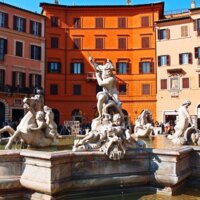
Water has managed to inspire and awe people for thousands of years. Fountains manage to take this water and turn it into an active spectacle. The Baroque era saw an increase of fountains in Rome, specifically ones commissioned by the Pope. Whether symbols of the Catholic church, war victories, or ways to get water to the people, fountains have had an important role for a long time. This exhibit will take you through a chronological journey of 10 fountains and their foundations in the city of Rome. This exhibit will discuss how fountains alter cityscapes, specifically that of Rome. From the grandiose power of the papacy to the access to water, fountains have had a vast role in Roman history. Fountains take the cityscape and the traditional piazza and transform them with great displays of power. They encourage people to gather in the piazza, and thus created common spaces where people were urged to come together. Fountains interact with one another and take inspiration from pre-existing fountains. Whether that be the revival of the wall fountain leading to the inspiration of the Fontana di Trevi or the interactions amongst the three fountains in the Piazza Navona, fountains never stand alone in the grand scheme of the city. Additionally, fountains reveal a lot about the patron. As an art form that takes place in the public sector, fountains are accessible by the everyday citizen and are not hidden away in private galleries. Thus the patrons were typically those with the most power, the Pope. As the Pope commissioned these grand displays of power, many times there were references to Christianity and their own individual familial histories and backgrounds. When fountains were commissioned by private patrons they were typically smaller scale and had vastly different purposes behind their commission. As an art form, fountains are unique, holding a public power quite unlike any other. They create public spaces for people to gather, they deliver water to the people, and they express the power of the patron. This exhibit will discuss these factors with the 10 fountains on an individual basis alongside a general background on each of them. Use the tabs on the rightside of the screen to navigate through the exhibition.
For a look at the spatial distribution of the fountains check out the link below:
https://earth.google.com/earth/d/1SFRzAQEWe1pazcej9Gbi-Pax_IeyTa2a?usp=sharing
The Harmony of Science and Religion: An Analysis of Practical Geometry in Borromini's Architecture
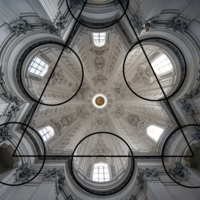
There seems to be an intrinsic, intellectual conflict between science and religion. Whether rooted in the debate of evolution versus creationism or more broadly in the belief that science can or cannot answer the troubling questions that have weighed on society for generations, there is a divide in thought. However, what truly separates these two systems, and are they inherently at odds?
Through an analysis of Francesco Borromini's architectural designs and prowess, it becomes apparent that perhaps religion and science do not need to be set in a never-ending quarrel but rather can co-exist in a harmonious relationship. Indeed, Borromini's utilization of perfectly geometric plans underscores the symbiotic relationship between the divine and the scientific!
Herein lies an analysis of the practical, scientific influences that shaped the major works of Francesco Borromini. Navigate through Borromini's design plans and explore the underlying geometric principles set forth by Galileo, Copernicus, Kepler, and Euclid that are illuminated and considered.
Through strict adherence to these laws of science, Borromini creates the unearthing physical experience of his ingenious architecture. Truly, he manifests both science and religion!