A Faun Teased by Children
Background
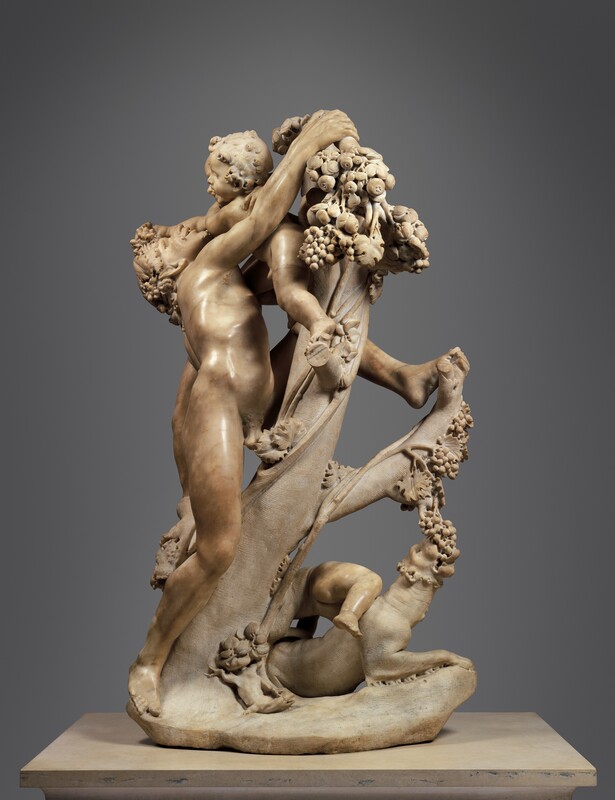
A Faun Teased by Children is one of Bernini’s earliest works. The artist completed this work in 1616 when he was about eighteen years old. Bernini completed this small yet masterful sculpture under the supervision of his father [1]. They worked on the sculpture in Pietro Bernini's workshop with each of them applying their individual and distinctive styles.
Visuals and Mythology
We see a faun engaging in a brawl with two cherubs. The faun is a bacchanal, a follower of Bacchus, the god of wine. As he attempts to drunkenly pick grapes, we see the group of putti playfully pushing him back [2]. The work is humorous in its demonstration as we see the two cherubs making amusing faces at the faun with one of the cherubs comically sticking their tongue out.
Context
There is mere speculation regarding the intended function. Its small size indicates that it was most likely supposed to serve as an interior ornament. It’s hard to imagine given its size that the sculpture would serve as a garden structure unless it was the crowning ornament of a fountain [3]. However, it’s more reasonable to assume that this work was most likely an interior piece further shown by the work’s intricate quality and detail. It is also not likely that this work was commissioned since the sculpture was discovered in the Bernini household. This could have possibly served as a learning experience for both father and son that was then used to decorate their interior household. Nonetheless, many scholars still speculate whether this piece was possibly commissioned by an affluent patron.
Analysis
The mythological depiction of this bacchanal follows the tradition of Hellenistic and Roman scenes with Bacchus children: an image that was popular during the Baroque period during the resurgence of mythological imagery after the Renaissance period [4]. Pietro Bernini excelled in sculpting these Bacchanal scenes and was highly praised for these works. We can see Pietro Bernini's iconic use of cottony textures and buoyant shapes when depicting this Bacchanal scene [5].
Interestingly, at such an early age, we can already see Bernini’s style forming within this work, contrasting his father’s distinctive art style. Bernini depicted the animals in the piece with such evident naturalness that clashes against his father’s more glorified representations [6]. Additionally, Bernini’s use of diagonal forms, which will become more pronounced in his later works, further clash with his father’s more artificial, buoyant forms. It’s clear that Pietro Bernini’s style is derived from mannerism. The young Gian Lorenzo was already challenging his father’s traditional mannerist style.
A Faun Teased by Children, all in all, is a symbolic work that represents the transition of artistic prowess from father to son [7]. Furthermore, this early work also represents one of Bernini’s initial endeavors in tackling mythological representation. This work was mostly seen as Bernini was a means to improve his craft under the instruction of his father; however, this artistic venture served as the foundation for his future, noteworthy mythological works.
References
- Bacchi, Andrea, and Anna Coliva. Bernini. Milano: Officina Libraria srl, (2017), 38.
- “Bacchanal: A Faun Teased by Children.” Metmuseum.org. Metropolitan Museum of Art. Accessed December 7, 2021.
- Bacchi, Andrea, and Anna Coliva. Bernini, 38-40.
- Preimesberger, Rudolf, and Michael Mezzatesta. "Bernini, Gianlorenzo." Grove Art Online. 2003; Accessed 7 Dec. 2021.
- “Bacchanal: A Faun Teased by Children.” Metmuseum.org. The Metropolitan Museum of Art. Accessed December 4, 2021.
- Preimesberger, "Bernini, Gialorenzo."
- Bacchi, Andrea, and Anna Coliva, Bernini, 38.