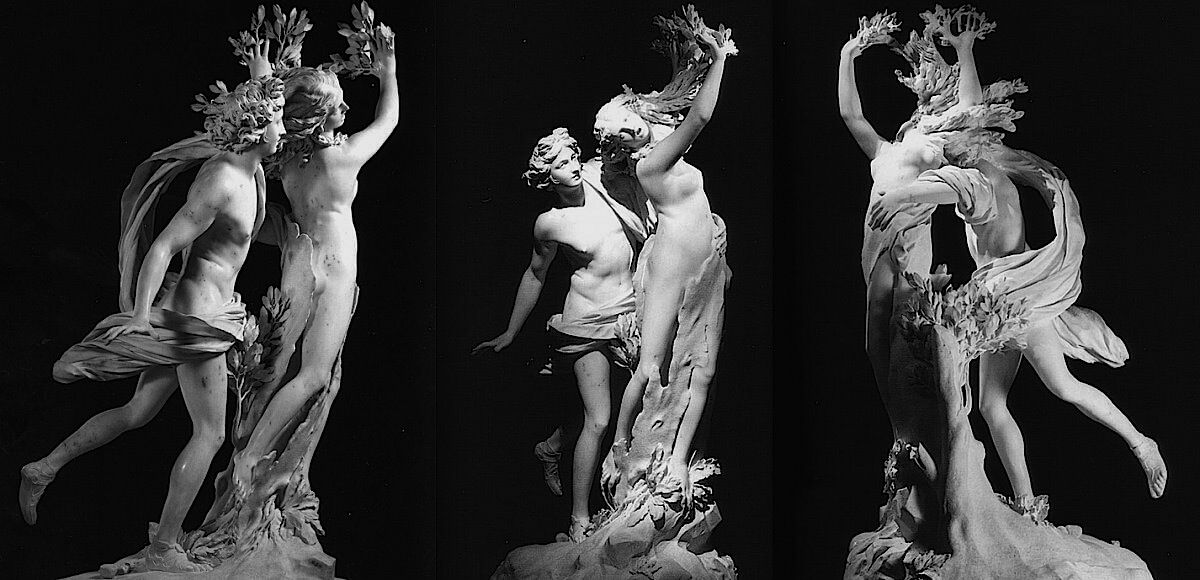
Medusa
Background
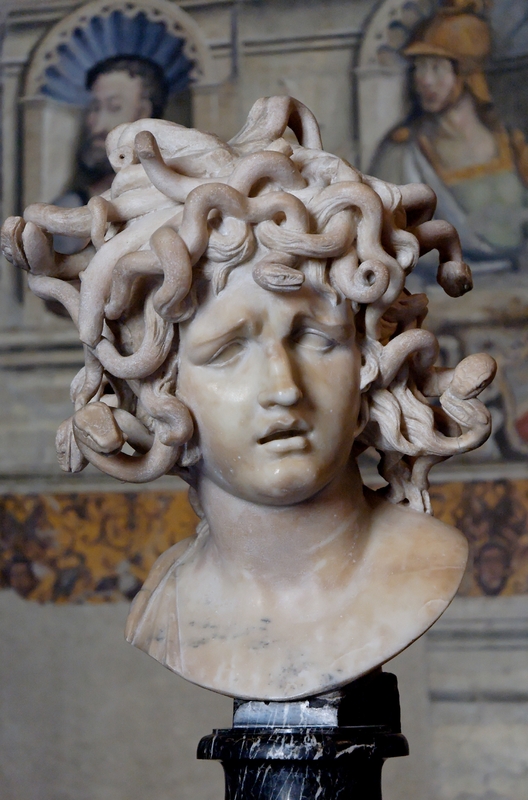
Bernini’s Medusa shows the figure amidst her transformation into a monster. Bernini’s depiction here is again heavily depicted by Ovid’s Metamorphosis. According to Ovid, Medusa was punished by Athena for having an affair with Poseidon in her heavenly temple. As a result, Athena turned her into a monster with “writhing snakes” [1]. It is not clear who commissioned this piece nor its purpose. Some believe that the subject possibly evokes a heraldic emblem of one of Bernini's mentors; however, this does not explain why Bernini portrays Medusa in such an unusual manner compared to her general depictions in past works of art. [2]
Caravaggio's Medusa and Bernini's Medusa
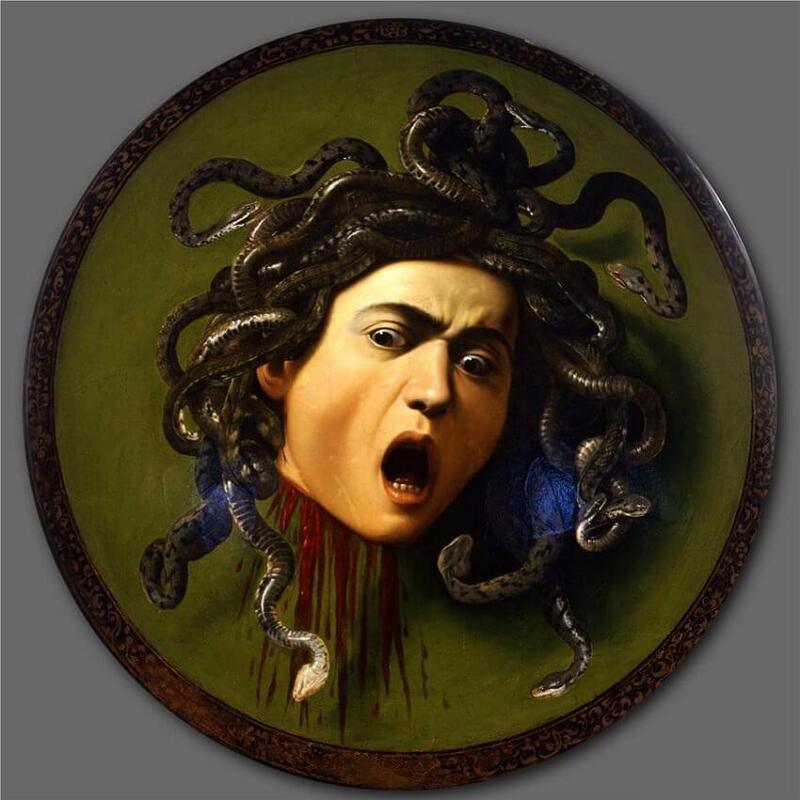
Medusa’s expression is quite different from how the figure is usually represented. We can see this stark contrast with Caravaggio's Medusa. This work was painted on a sixteenth-century tournament shield and was commissioned by Cardinal del Monte [3]. Caravaggio chose to depict Medusa in a terrifying manner with a horrified expression. Caravaggio and Bernini choose different points of Medusa’s story. Caravaggio paints her at the moment of her death when Perseus kills her. Her decapitated head is shown on the shield with bright blood dramatically splattering out. Medusa is commonly drawn on shields in this manner. She serves as an apotropaic symbol meant to ward off the negative; she represents an evil force that is meant to deter other lethal threats [4].
As stated previously, Bernini instead demonstrates Medusa in her moment of transformation according to Ovid. The Roma poet described in The Metamorphosis, Medusa as a beautiful maiden who was admired by various suitors and was the most gorgeous among the three Gorgon sisters [5]. Bernini renders her face delicately and gracefully. You can see beyond her horrific transformation the beautiful woman she used to be.
Analysis
Bernini showcases the agony of this transformation. You are meant to sympathize with this heinous punishment. Medusa is contorted with pain and worry; her mouth is slightly open, revealing her inner shock and attempt to cry out [6]. Bernini captures Medusa’s humanity which is not illustrated in Caravaggio’s piece. We can further see how Bernini depicts Medusa in a humane by the fact that Bernini does not depict her decapitated head but instead sculpts her as a portrait bust [7]. She is given the same treatment as the wealthy and royal figures Bernini commonly sculpted in bust form. The piece overall represents a portrait of a woman undergoing a heinous conversion. The theme of metamorphosis is further underscored by the fact that Medusa has not only transformed into a monster but into a marble stone structure. This meta-transformation depicts Medusa as transformed into stone-- the punishment she inflicts on her enemies.
Bernini aims to paint her in an emotional and in pathetic, moving fashion. These themes of sympathy and pain are commonly depicted in many of the counter-reformation works in this time especially when depicting Christian martyrs and Mary Magdalene. Bernini is translating this common manner of depicting emotionally-filled Christain stories within this mythological work.
References
- “Bernini's Medusa.” FAMSF, August 21, 2019. https://www.famsf.org/press-room/berninis-medusa.
- Medusa: Posèq, Avigdor W. G. “On Physiognomic Communication in Bernini.” Artibus et Historiae 27, no. 54 (2006), 165.
- Donatello and Caravaggio: The Iconography of Decapitation: Schneider, Laurie. “Donatello and Caravaggio: The Iconography of Decapitation.” American Imago 33, no. 1 (1976), 84. http://www.jstor.org/stable/26303021.
- Glennon, Madeleine. “Medusa in Ancient Greek Art.” In Heilbrunn Timeline of Art History. New York: The Metropolitan Museum of Art, 2000–. http://www.metmuseum.org/toah/hd/medu/hd_medu.htm (March 2017)
- Glennon, “Medusa in Ancient Greek Art."
- “Bernini's Medusa.” FAMSF, August 21, 2019. https://www.famsf.org/press-room/berninis-medusa.
- Lavin, Irving. "Bernini’s Bust of the Medusa: An Awful Pun." (2019), 165.