A Comparison of Female Portraiture
Fontana: Portrait of a Noblewoman
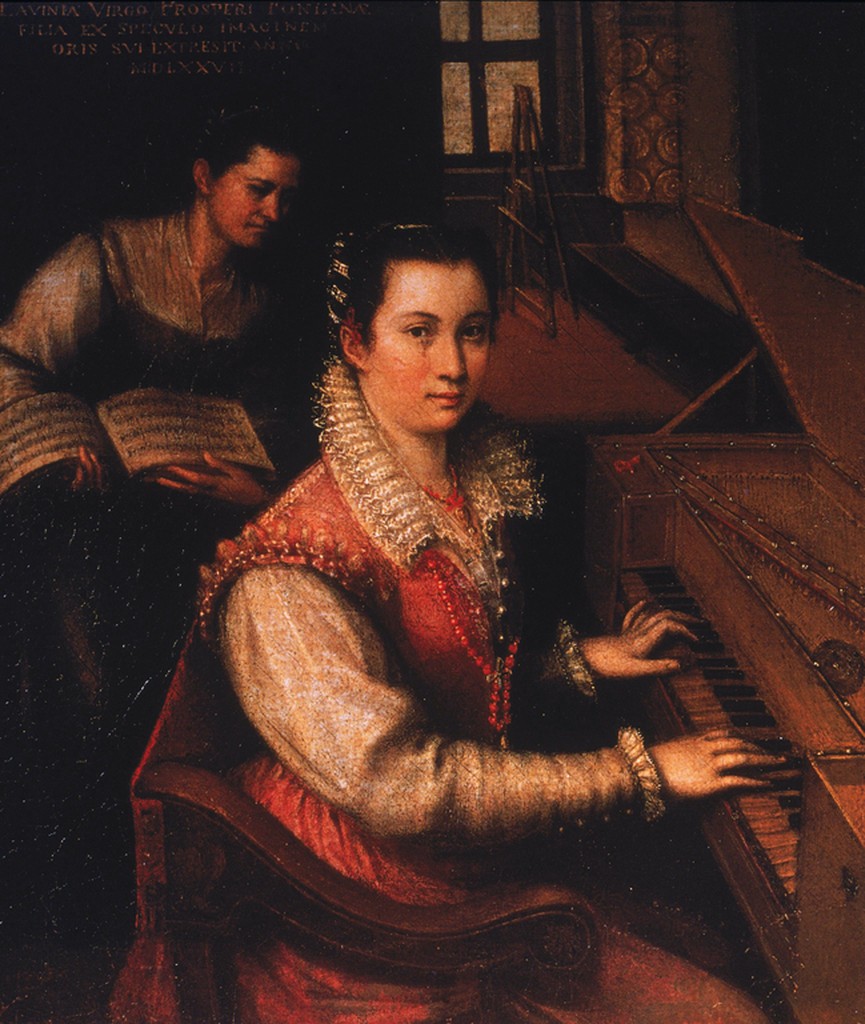
Fontana was born into a humble family. Her father, Prospero, was a local painter in Bologna and served as her teacher. Likely, their financial troubles led to Prospero training Lavinia in the arts. Working in her father's workshop, Lavinia was exposed to smaller commission projects at an early age and quickly adopted many of his stylistic approaches – most notably an emphasis on jewelry and coloration [1]. Lavinia began commanding her style of painting. She separated herself from her contemporaries, relying on commissions in her urban workshop in Bologna as her source of income. This differed greatly from other female artists who tended to rely on clergy or court positions for more stable forms of income. Nonetheless, Lavinia found financial security and success due in large part to her clientele base – Bolognese noblewomen [2]. Fontana portraits became a prized possession for this class of individuals and thus provided the financial foundation for her and her eleven children and husband. Lavinia’s relationship with these women extended beyond a transactional engagement, for she was idolized and beloved among the group. This is emphasized by the fact that many of her female clients stood as godparents for Lavinia’s children.
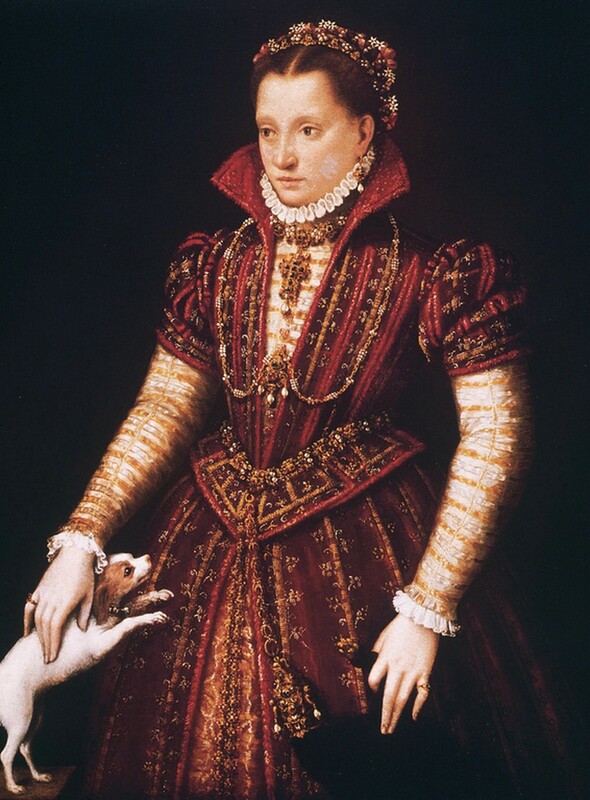
This intmiate relationship between Fontana and the Bolognese noblewomen is exemplifed in the portrait above. Fontana dresses the subject in a delicately crafted red gown – presumably a customary Bolognese wedding dress [2]. Immense detail is paid towards the development of this garb and the jewelry bedazzling on top. The artist uses geometrically symmetric weaving patterns in the mid-torso area in conjunction with parallel longitudinal stitching to highlight the subject’s physique. Moreover, the interspersed golden stitching and silver lacing adds to the regality emanating from the portrait. The colorful dress is styled with meticulous jewelry across the brooch and extremities. Fontana’s commanding brush control is well-expressed in these aspects of the painting. Even minutia such as the fine details of chain links is pristinely acknowledged. The artist handles the construction of the opulent jewelry with warranted delicacy. The symmetric beauty of the painting is furthered in the facial construction of the subject. The subject is devoid of facial impurities, complimenting the untampered beauty of the dress.
Anguissola: Portrait of a Nun
Anguissola was born a noblewoman; however, her family had similar financial troubles to Fontana. Her father, Amilcare, pushed Anguissola and her sisters to become artists. They studied under the tutelage of local painter Bernardo Campi. During which time, Anguissola quickly established herself as an excellent portrait painter [3]. Compared to Fontana, Anguissola’s subjects were not limited to women as she often painted noblemen and clerics [4]. Yet, early in her career, Sofonisba utilized her sisters as subjects. In these portraits, the unimposing female subjects were often depicting engaging in intellectually stimulating activities. This conflicted with the expectations of females at the time. Anguissola balanced between appeasing the proper expectations of females and utilizing her art to express womanhood and female power. Unlike Lavinia, Anguissola did not rely on commission-based income. Rather, she gifted away her paintings to noblemen and noblewomen in hopes of some reciprocity. Luckily, her efforts were not in vain when she was asked to be a court painter for Isabelle de Valois, the wife of Phillip II of Spain [5].
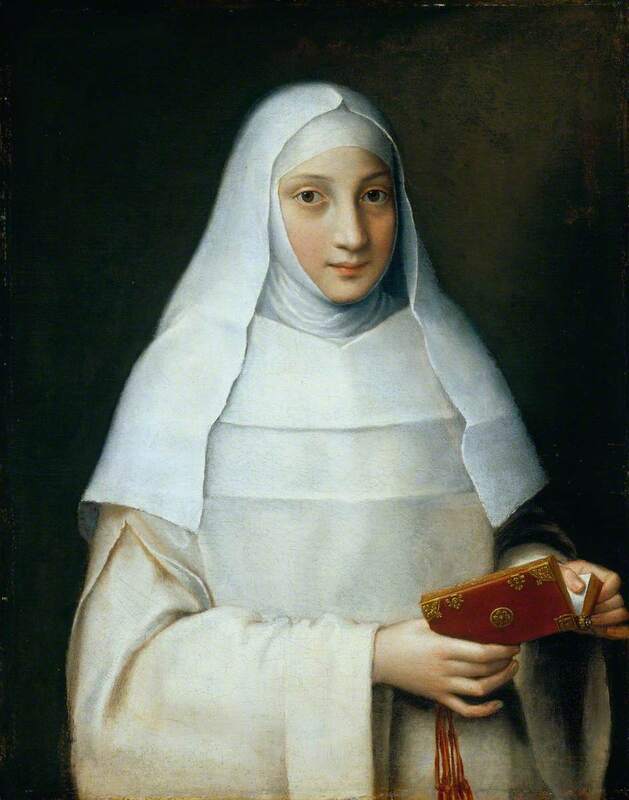
In the portait above, Anguissola depicts her subject in front of a monotonous black background. However, the nun’s white religious habit is slightly enveloped by the background. Sofonisba plays with this light-dark contrast, highlighting the subject's face and outward-facing half. Through such interplay with the background, there is a slight dynamism developed in the painting - the subject's left arm emerges from the background adding a sense of depth and perspective. Such techniques help breathe a sense of life into the nun. Moreover, the subject stands in a natural, comfortable posture with her religious habit draping over her shoulders and arm. Anguissola relies on longer brush strokes and slight shadings to further this life-like portrait. Exquisite coloring and fine details are exchanged for more subtle color palette alterations. And yet, a familiar sense of prowess is conveyed through such artistic means. The nun’s piercing eye contact and steady posture radiate resolve and conviction.
Comparison
While often discussed as a single category, female Italian baroque artists encompass a variety of artistic techniques, financial models, and family backgrounds. Lavinia Fontana and Sofonisba Anguissola exemplify such diversity.
This dichotomy between the artists is expressed in a comparison between their portraits. Initially, there is a striking resemblance between the two paintings. Both artists place a female subject in front of a non-decorated black background. An illuminating streak crosses from left to right accenting the seemingly expressionless faces of the female subjects. Both depict an example of female beauty and purity: one through opulence and another through devote religion. Moreover, each artist holds a personal relationship with their respective subject. Such closeness is expressed through soft detailing of facial features.
And yet, there are profound differences between the two portraits as they serve to express each artist’s unique portraiture techniques. Fontana relied on short brush strokes, and geometrical symmetries to highlight the beauty and prowess of the subject. Whereas Anguissola made use of foreground-background interplay, light contrasts, and broad stroke shading to develop a composed yet dynamic and forceful subject. The two artists utilized differing and often contrasting techniques, and yet both successfully characterized their female subjects with power and confidence.
References
[1] McIver, Katherine A. “Lavinia Fontana’s ‘Self-Portrait Making Music.’” Woman’s Art Journal 19, no. 1 (1998): 3–8. https://doi.org/10.2307/1358647.
[2] Murphy, Caroline Patricia. “Lavinia Fontana: An Artist and Her Society in Late Sixteenth Century Bologna.” Dissertation, ProQuest LLC, 2016.
[3] Jacobs, Frederika H. “Woman’s Capacity to Create: The Unusual Case of Sofonisba Anguissola.” Renaissance Quarterly47, no. 1 (1994): 74–101. https://doi.org/10.2307/2863112.
[4] Robin, Diana Maury, and Anne R. Larsen. “Anguissola Sofonisba.” Essay. In Encyclopedia of Women in the Renaissance: Italy, France, and England, 14–18. Santa Barbara, CA: ABC-CLIO, 2007.
[5] Murphy, Caroline P. “The Economics of the Woman Artist.” In Italian Women Artists from Renaissance to Baroque, ed. Vera Fortunati et al., 23–30. Milan: Skira, 2007.