Venus and Cupid
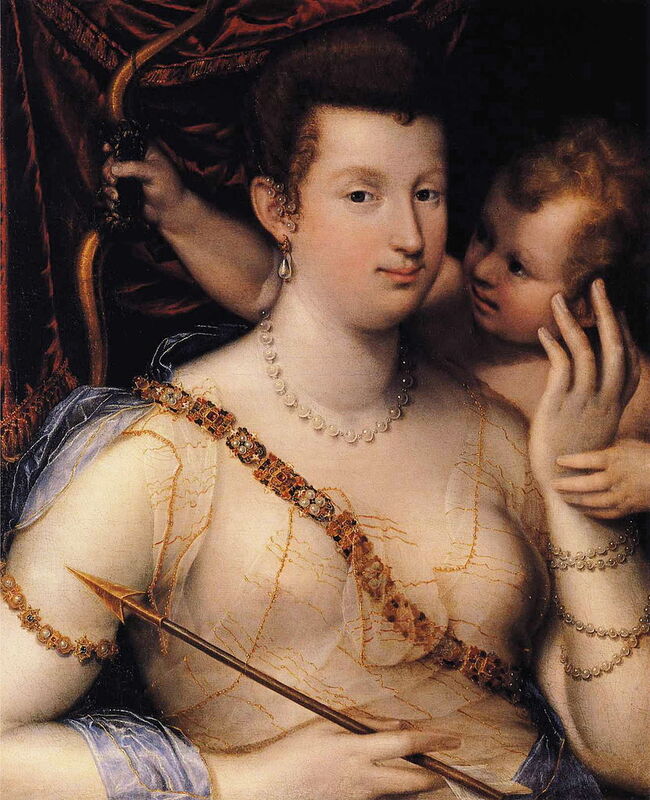
Fontana: Venus and Cupid
This is a portrait of Isabella Ruini as Venus. A transparent veil stitched with gold thread of extraordinary delicacy reveals the marmoreal body of this Venus with a slender throat and delicate features, brought out to their best advantage by jewelry of incredible sumptuousness. Cupid, hiding in the back and holding Venus' hand, is looking gently at Venus.
In classical mythology, Cupid is the god of desire, erotic love, attraction, and affection. He is often portrayed as the son of the love goddess Venus and the god of war Mars. Cupid is usually shown amusing himself with adult play. He is often depicted with his mother Venus, playing a horn[1]. Venus, the goddess of sexuality, became a popular subject of painting and sculpture during the Renaissance period in Europe. As a "classical" figure, nudity was her natural state, so it was socially acceptable to depict her unclothed[2]. Throughout history, many famous artists have depicted Venus and Cupid together on their canvas, including Artemisia Gentileschi, Lorenzo Lotto, and Pontormo.
This painting is a disguised portrait, a method of depicting the most prominent courtiers designed to glorify the aristocrat concerned. In this manner, women are portrayed in bust format, with idealized bodies depicted in the image of Diana or, as in this case, Venus. The subject here is probably a lady of the Ruini family, as suggested by a sketch of a similar-looking model by Cristoforo dell’Altissimo, conserved at the Pitti Palace in Florence. It may have been an engagement portrait sent to the future husband[3]. According to Buckley, by depicting her patron as Venus, Fontana played with the long-standing tradition of classical revivalism in Renaissance art, so depicting Ruini nearly nude could be permitted[4].
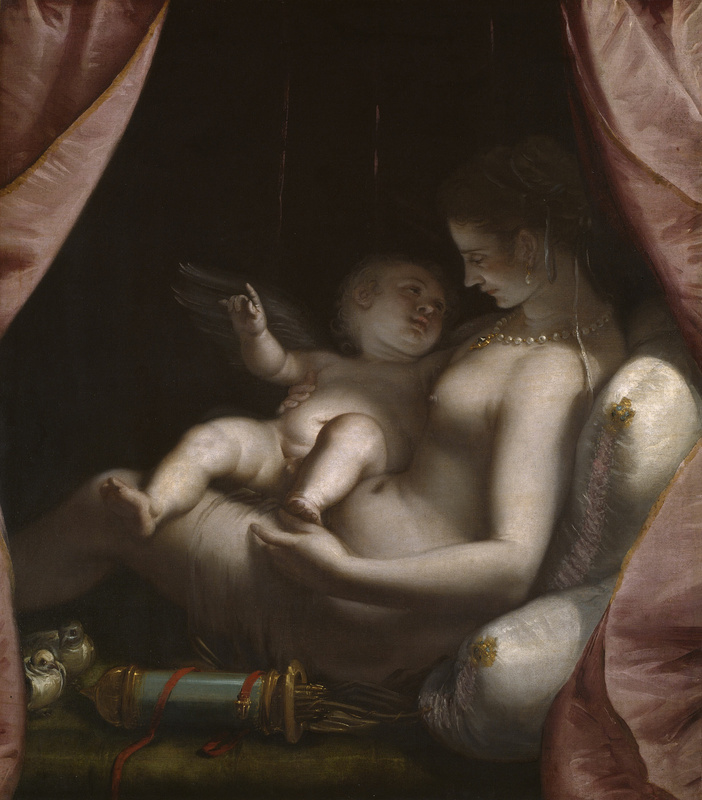
Cambiaso: Venus and Cupid
This painting was completed by the Italian Mannerist artist Luca Cambiaso (1527-1585) in his middle period, which, according to Sweet, was his best period when his style was more subdued and more highly finished[5]. Against an almost black background Venus is reclining against satin covered cushions, holding in her lap a youthful Cupid who extends his right arm. Their nude bodies, beautifully modeled, appear in almost sculptural roundness bathed in a cold light which imparts a delicate mauve tone to the flesh. At either side are rich purple hangings, and in the foreground is Cupid's quiver of arrows, brilliant turquoise blue with red straps. At the left are two turtledoves. Though possessing the strongly marked three-dimensional feeling and compact composition so typical of Mannerist paintings, this canvas has, in addition, all the elegance of a Titian together with an extraordinary and quite unique color arrangement[5].
Comparison
The two paintings are similar in terms of style, texture, contour, scale, setting, and context. Both paintings include the same subject Cupid in a realistic style. They both have a soft and smooth texture. The contours of the subjects are gentle and blend well with the shadows on the skin or the dark background. There is obvious contrast in terms of light and shadow. In both works, Cupid is looking at Venus’ face with a baby-like scale compared to Venus. There are similar settings surrounding the subject matters in both works, including arrows and curtains. Moreover, Venus is wearing a pearl necklace. In addition, contextually, the two artists' similar time periods and close locations contributed to their similarities in styles. Fontana (1552-1614) was active in Bologna[4]. Cambiaso (1527-1585) was the leading artist in Genoa[5]. Both of them came from the northern part of Italy in the mid-sixteenth century.
Despite the similarities, the two paintings differ in genre, hue, composition, contrast, and arrangement of light. While Cambiaso's work depicts mythological figures Venus and Cupid, Fontana's work is portraiture, in this case a portrait of the real person, Isabella Ruini, in the guise of the mythological figure, Venus. Cambiaso’s work is less saturated with paler and cooler colors. While Fontana’s canvas is almost full, Cambiaso uses more negative spaces. Fontana utilizes a composition that is typical of portrait painting where the subject has direct eye contact with the viewers, while Cambiaso puts his subject vertically to each other, creating visual interest and a sense of depth. In Fontana’s painting, Cupid is in the back and two-thirds of his body are covered in shadow, and both subjects have a part, if not all, of their faces in the light. Moreover, most of the light is arranged on Venus. In contrast, in Cambiaso’s work, both Venus’ and Cupid’s faces are covered in shadow. The brightest highlight seems to lie on Cupid’s belly and legs.
References
[1] Wikipedia contributors, "Cupid," Wikipedia, The Free Encyclopedia, https://en.wikipedia.org/w/index.php?title=Cupid&oldid=1052178603 (accessed October 27, 2021).
[2] New World Encyclopedia contributors, "Venus (mythology)," New World Encyclopedia, , https://www.newworldencyclopedia.org/p/index.php?title=Venus_(mythology)&oldid=993464 (accessed October 27, 2021).
[3] "Venus and Cupid." Musee des Beaux-Arts, June 18, 2013. https://mbarouen.fr/en/oeuvres/venus-and-cupid (accessed October 27, 2021).
[4] Buckley, Kat. “Lavinia Fontana: Immortalizing Morality .” Critical Perspectives in Fashion, October 2015. https://www.researchgate.net/profile/Kat-Zagaria/publication/303688203_Lavinia_Fontana_Immortalizing_Morality/links/574d968f08ae82d2c6bde109/Lavinia-Fontana-Immortalizing-Morality.pdf.
[5] Sweet, Frederick A. “Venus and Cupid by Luca Cambiaso.” Bulletin of the Art Institute of Chicago (1907-1951) 37, no. 1 (1943): 2–3. https://doi.org/10.2307/4116877.