Browse Items (149 total)
Sort by:
Self-portrait at the Clavichord
This self-portrait of Lavinia Fontana depicts the artist playing the clavichord, an appropriately cultured activity for a rising noblewoman. The seated Fontana is resplendent in an intricate red gown decorated with jewels and a lace collar. Brightly…
Portrait of a Noblewoman
Lavinia Fontana was born and educated in Bologna towards the end of the 16th century. During this time, Bologna was remarkably progressive, compared to other Italian cities, regarding its opportunities for women – both educationally and economically.…
Venus and Cupid
This painting was completed by the Italian Mannerist artist Luca Cambiaso (1527-1585), a leading artist in Genoa in the 16th century. The painting was done in his middle period, which was his best period when his style was more subdued and more…
Judith and her Maidservant
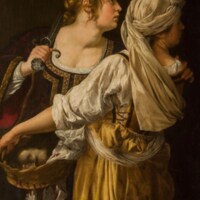
This painting was originally documented in 1638 to be in the possession of the Grand Duchess Maria Maddalena of Austria. This painting was based on Artemisia's fathers' artwork, "Judith and her maidservant with the head of Holofernes", c. 1608, by…
Esther before Ahasuerus
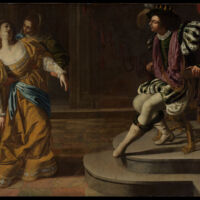
Considered to be one of the most ambitious paintings in Gentileschi’s œuvre, Esther before Ahasuerus exemplifies her success as a female baroque artist. The Old Testament Story referenced here is that of Queen Esther and her husband, Ahasuerus, the…
Antonio Moro's Self Portrait
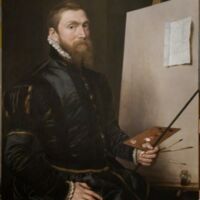
In the 1500s, there was a rise of artworks that represented this theme of the allegory of art or "pittura."
It's crucial to understand that before the sixteenth century painting was not considered a liberal art and was not considered an…
It's crucial to understand that before the sixteenth century painting was not considered a liberal art and was not considered an…
Self Portrait as the Allegory of Painting
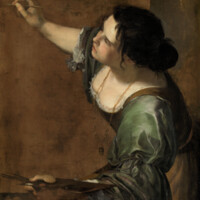
In this work, Gentileschi depicts herself in the act of painting. Gentileschi most likely completed this painting during her brief English sojourn (1638-c.1641) where she was invited by Charles I to join her father Orazio Gentileschi who had been…
Venus and Cupid
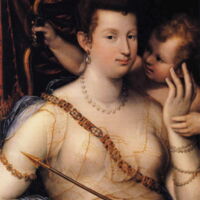
This is a portrait of Isabella Ruini as Venus. A transparent veil stitched with gold thread of extraordinary delicacy reveals the marmoreal body of this Venus with a slender throat and delicate features, brought out to their best advantage by jewelry…
Les femmes illustres, ou, Les harangues heroïques
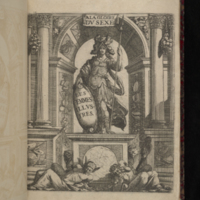
French philosopher Madeleine de Scudéry was a prolific writer. Her novels and books were published under her brother’s name. She embraced philosophical dialogue as a means to explore questions of gender, sexuality, education, and power. Scudéry was…